2017issue C0418-21
A coin-flip timed exit as the skill floor for trend and mean-reversion
A historical workflow scored trend-following and mean-reversion entries with the same twelve-week timed exit as a random entry, then asked whether return on account cleared buy-and-hold. Editorial view: a rule earns classroom attention only if it clears both the passive reading and that no-skill floor on the same instrument.
- Return on account, defined as net profit divided by maximum drawdown, was the single-number snapshot used to treat a procedure as beating passive market exposure when it exceeded buy-and-hold.
- Trend-following, down-close mean-reversion, and a coin-flip entry were each paired with the same twelve-week timed exit so differences came from the entry idea.
- A result similar to the random baseline was treated as a reason not to credit a rule with skill, because a coin flip would then be the simpler procedure.
- The runs omitted commissions, slippage, and dividends, and the evaluation argued that instruments with different volatility may favor different rule families.
A single snapshot against passive holding
A trading procedure was treated as beating a passive market exposure when its return-on-account reading exceeded the buy-and-hold reading. Return on account was defined as net profit divided by maximum drawdown and used as a single-number risk-reward snapshot.
That snapshot was the scoreboard for the whole comparison. Entry, exit, and standing aside were judged together, not as separate flourishes.
One timed exit for three entry ideas
Active rules were scored against a no-skill baseline that entered at random and exited after a fixed twelve-week hold. That coin-flip no-skill baseline is a quantitative forecast drawn from ordered market observations over a defined sampling interval, then paired with the same hold so other historical tests have an explicit hurdle.
A trend-following procedure bought when a trend was presumed to start and sold after twelve weeks. It was run on the same instrument and window as the other rules. Beside it, a mean-reversion procedure bought a weekly bar that closed below its open and sold after the same twelve weeks. The shared timed exit kept the holding period fixed so the comparison isolated the entry idea rather than mismatched exit clocks.
SPY return-on-account by entry rule, 2000–2016
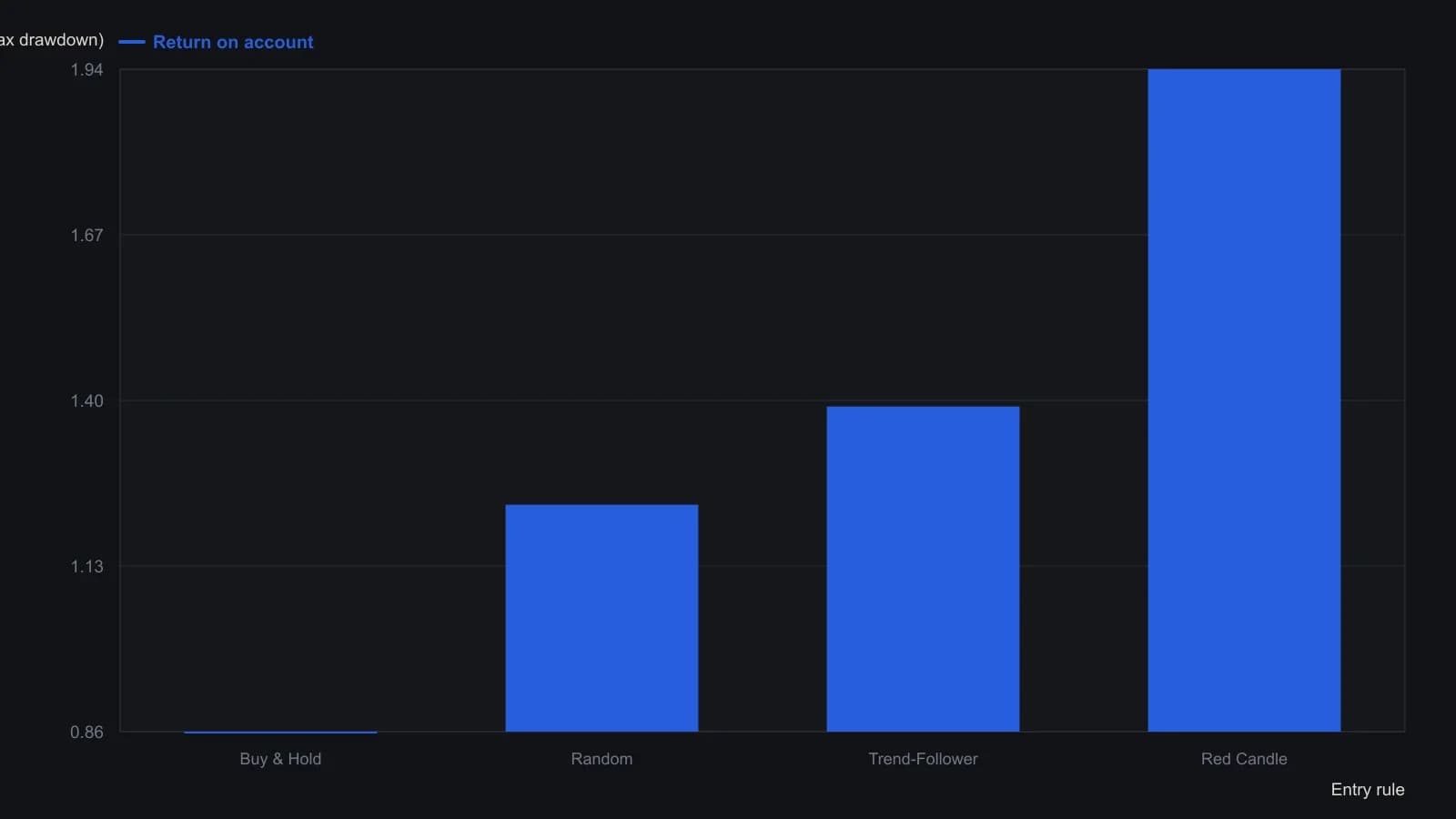
The source backtests exclude commission, slippage, and dividends. Active rules exit 12 weeks after entry.
When the coin flip is the simpler procedure
A result similar to the random baseline was treated as a reason not to credit a rule with skill, because a coin flip would then be the simpler procedure. The write-up attributed the relative standing of the down-close timed-exit rule to the tested index often mean-reverting rather than sustaining trends.
What the comparison left out
The historical comparison table noted that commissions, slippage, and dividends were omitted from the runs. The evaluation argued that instruments with different volatility may favor different rule families, so one logic should not be assumed to travel unchanged.
All readings on this track · 6 readings
- 1986Skill score versus a coin-flip forecast baseline
- 1991Evaluating a trailing stop against a coin-flip entry
- 2004Evaluating trend rules against no-skill baselines
- 2005Evaluating systems with walk-forward analysis, robustness testing, and coin-flip baselines
- 2015Trade-tape entropy versus a coin-flip no-skill baseline
- 2017A coin-flip timed exit as the skill floor for trend and mean-reversion