2017issue C1222-23
Contango, carry, and contract choice in equity-index volatility futures
Equity-index volatility futures often sit above the cash-volatility-index, with later months priced higher still. Editorial reading: a long-volatility idea is a three-part regime problem covering the implied-volatility level, the carry in the curve, and which expiration is held.
- Equity-index volatility futures often sit above the cash-volatility-index, and each later expiration is often priced higher than the one before it.
- Futures-spot-convergence can erase a long contract's premium if the cash index stays put, and a rise that only fills the contango gap can leave the holder roughly flat.
- Volatility-index commodity-carry prices extra calendar time for a volatility event, whereas grain-futures contango often prices physical storage.
- A volatility-etp-basket typically mixes expirations, adding rebalancing costs and more distant, carry-heavy months than a single nearby future.
A three-part regime problem
Editorial reading: treat a long-volatility idea as a three-part regime problem. The first part is the implied-volatility level being bought. The second is the commodity-carry sitting in the futures curve. The third is contract-selection, the expiration actually held.
The archive facts describe a historical curve, not a claim that fear will rise. Equity-index volatility futures often sit above the cash-volatility-index, with each later expiration priced higher than the one before it.
That shape is contango. Later expirations price above nearer ones and above the cash index, so a long holder pays a roll or hold cost if spot does not rise enough.
What the contemporaneous snapshot shows
In the contemporaneous snapshot, the cash-volatility-index was 9.65 while successive futures printed 9.95, 12.50, 13.15, and 14.30 as expiration receded.
A long November contract bought at 12.50 and held to expiration would lose about 2.85 points if the cash index stayed at 9.65. Futures-spot-convergence requires the future and the cash index to meet at expiration, so any initial premium disappears if the cash index does not catch up.
Even a nearly three-point rise in the cash index can leave the long futures holder only roughly flat, because that rise may merely close the initial contango gap.
VIX cash versus nearby futures at the column snapshot
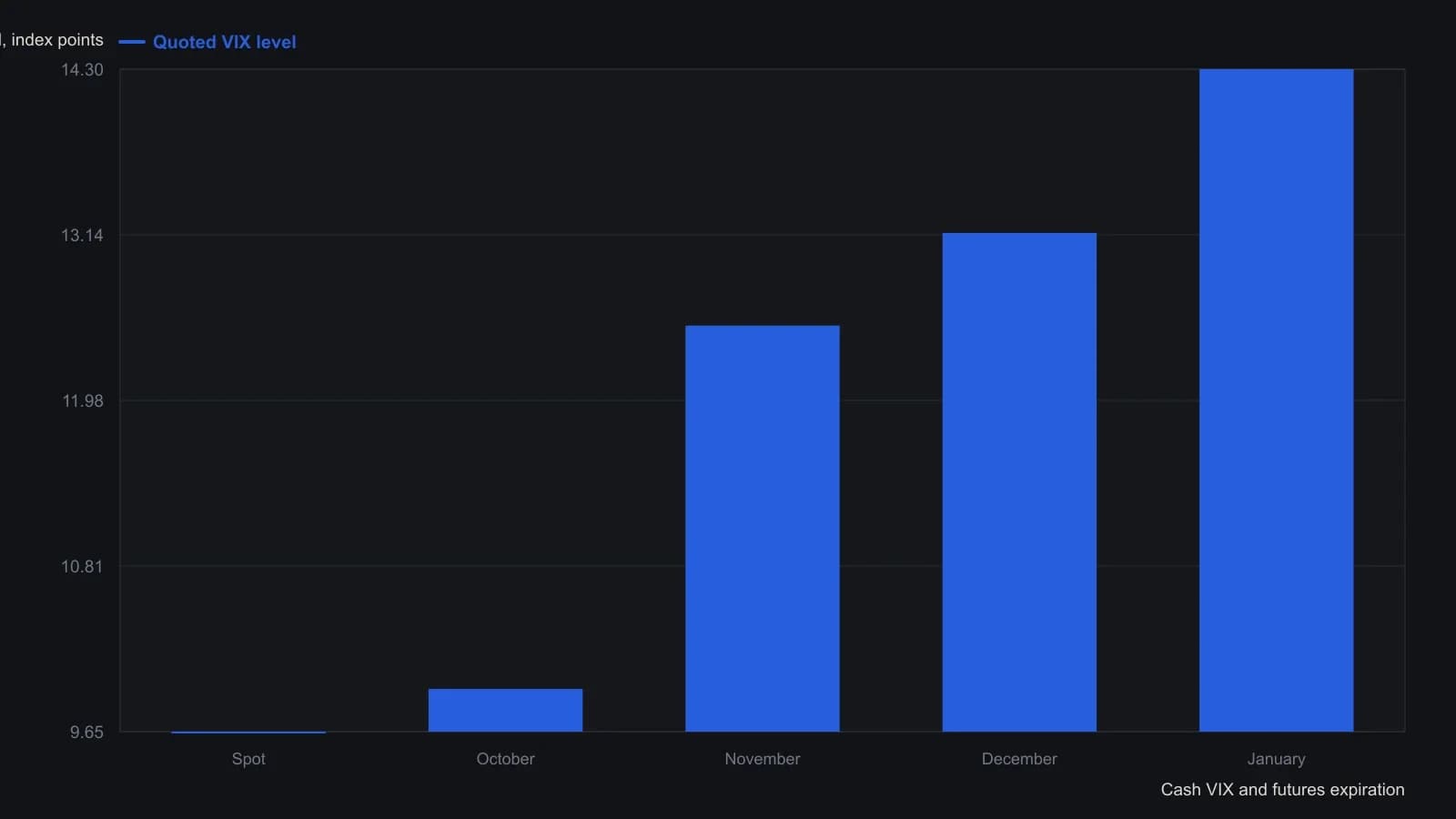
Single-day snapshot from when the column was written; October was the then-front VIX futures month.
Why volatility carry is not grain storage
Grain-futures contango often prices physical storage carry. Volatility-index commodity-carry instead prices the market's view that more calendar time raises the chance of a volatility event.
Because the cash-volatility-index is built from implied-volatility in S&P options, a long volatility-futures position is economically similar to being long index puts.
Baskets, distant months, and the usual path
Exchange-traded products meant to track volatility futures typically hold a mix of expirations. A volatility-etp-basket therefore adds rebalancing costs and greater exposure to distant, carry-heavy months than a single nearby future.
The cash-volatility-index more often drifts lower between shocks and can also fade quickly after a spike, a path that is roughly the inverse of the equity index itself.
Editorial reading: contract-selection decides how much contango must be overcome and how quickly that premium erodes. A more distant month, or a wrapper that leans into those months, asks the cash index to rise further before a long stance is even roughly flat.
All readings on this track · 9 readings
- 1990Building index futures fair value from cash-and-carry
- 2000Build a four-market commodity overlay for inflation regime context
- 2010Softs stocks-to-use and semiannual event windows
- 2012Contango and credit risk in listed commodity and volatility wrappers
- 2014A cheap-looking long in volatility-index futures is a classroom, not a fear hedge
- 2015A wide Treasury calendar and the 2015 delivery gap
- 2015A 2015 forced unwind is not a commodity-regime verdict
- 2017Contango, carry, and contract choice in equity-index volatility futures
- 2018One commodity-index future, three classroom decisions