2012issue C0650-51
Contango and credit risk in listed commodity and volatility wrappers
An adverse session in a listed commodity or volatility product is not a reason to extend the hold overnight. Editorially, that hold is a weeks-to-months regime test of futures carry, the implied-volatility curve, fees, and issuer exposure before the ticker is treated as an asset-allocation sleeve or a bounce vehicle.
- An adverse intraday move in a listed commodity or volatility product is not, by itself, a reason to extend the hold overnight.
- A listed commodity wrapper that holds near-month futures and rolls before expiry can turn a persistent contango curve into a loss on each roll, while the expense ratio and creation-mechanism constraints remain in force.
- A listed volatility note is an unsecured obligation, so a multi-week hold includes issuer credit exposure, any drag from a contango implied-volatility curve, and the product fee.
- Using either product as an asset-allocation sleeve does not remove roll decay, fees, creation limits, or issuer exposure.
Overnight hold as a regime test
Leveraged listed funds, futures-backed listed funds, and listed notes were grouped as product classes that can surprise holders who treat them as simple directional bets.
Editorially, a single overnight hold in a listed commodity or volatility wrapper is a weeks-to-months regime test. Futures carry, the implied-volatility curve, fees, and issuer exposure belong in that reading before the ticker is treated as an asset-allocation sleeve or a bounce vehicle.
Contango in a listed commodity wrapper
A listed commodity wrapper seeks commodity exposure through near-month futures or related swaps rather than by holding the physical commodity or related equities.
A listed natural-gas fund that holds near-month futures and rolls before expiry can convert a persistent contango curve into a loss on each roll. Contango is a futures curve in which later expiries sit above spot, so rolling a long near-month position into the next contract can lock in a loss. A roll replaces an expiring futures position with a later-dated contract to avoid physical delivery.
That fund was described as charging an expense ratio, the annual product fee that continues to accrue across a multi-week or multi-month hold. After futures purchase limits were reached, swaps were used in new-share creation. The same futures-backed natural-gas fund is sometimes used as an asset-allocation sleeve even while roll decay, expenses, and creation-mechanism constraints remain in force.
UNG split-adjusted share price, 2007–2012
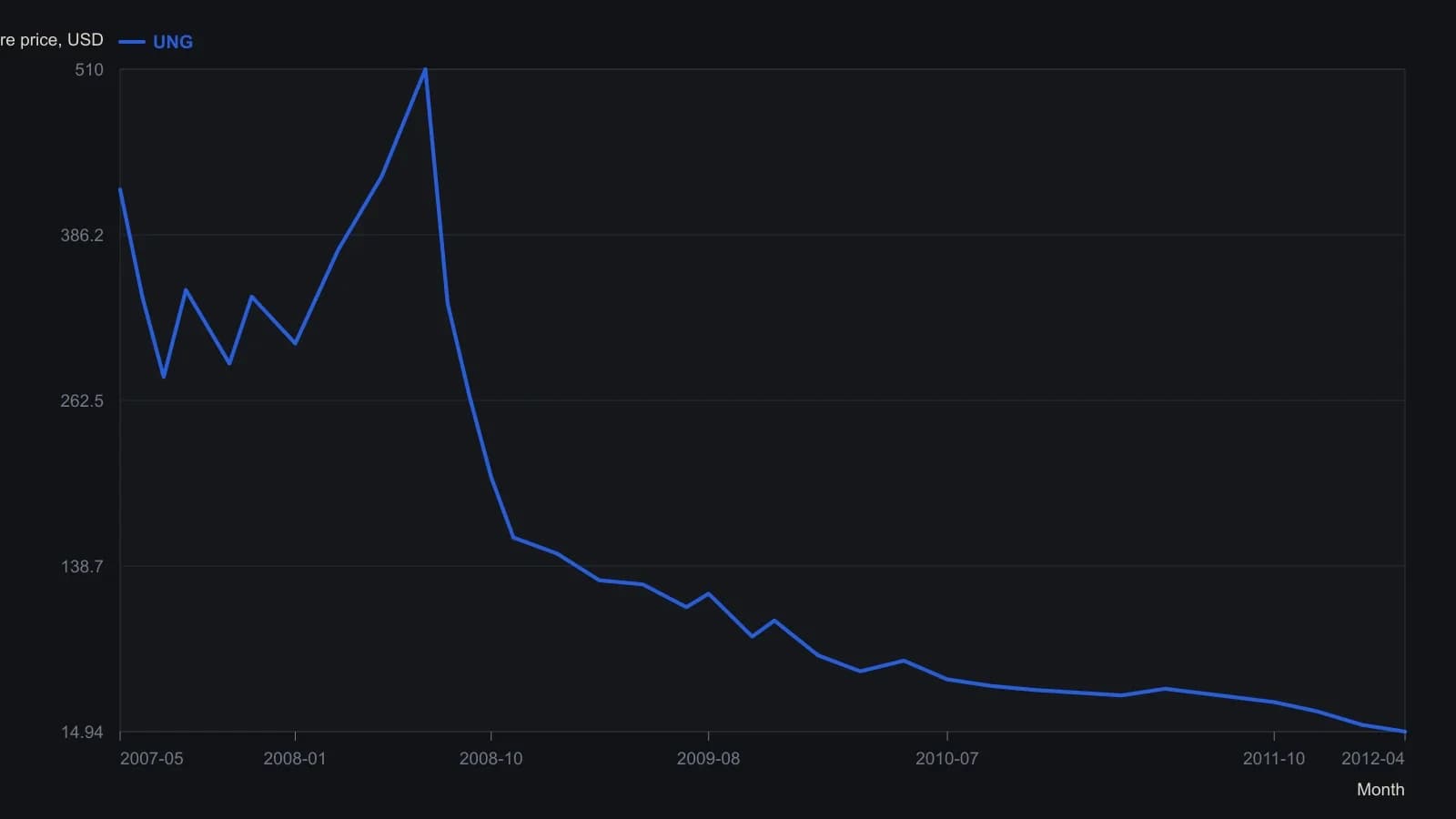
Digitized from a split-adjusted eSignal daily plot. Reverse-split marks (1-for-2 and 1-for-4) do not gap the series. On a 0–520 scale, early prices are readable to about the nearest five dollars; later prints hug the floor and are only approximate except the labeled close.
Credit risk on a listed volatility note
A volatility note is a listed unsecured obligation that tracks a volatility-futures path, so a multi-week hold includes issuer credit exposure as well as the volatility path.
Volatility futures used to hedge a rise in implied volatility were described as remaining in contango. The implied-volatility curve is the pricing of volatility futures across expiries. A persistent upward slope can drain a long volatility wrapper even if a volatility spike is expected later. The note's expense ratio added a further drag on a long hold.
The allocation sleeve still carries the structure
An asset-allocation sleeve uses a listed commodity or volatility product as a portfolio building block rather than as a short-horizon trade.
Editorially, that use does not retire roll decay, the implied-volatility curve, the expense ratio, creation-mechanism constraints, or issuer credit. Those features stay in force for as long as the hold lasts.
All readings on this track · 9 readings
- 1990Building index futures fair value from cash-and-carry
- 2000Build a four-market commodity overlay for inflation regime context
- 2010Softs stocks-to-use and semiannual event windows
- 2012Contango and credit risk in listed commodity and volatility wrappers
- 2014A cheap-looking long in volatility-index futures is a classroom, not a fear hedge
- 2015A wide Treasury calendar and the 2015 delivery gap
- 2015A 2015 forced unwind is not a commodity-regime verdict
- 2017Contango, carry, and contract choice in equity-index volatility futures
- 2018One commodity-index future, three classroom decisions