2018issue C0841
One commodity-index future, three classroom decisions
A listed commodity-index future already packages a roll calendar, a weight-capped basket, and a choice between posted-margin and full notional-contract-value. This archive case treats those three choices as one classroom ticket.
- The listed future inherits a roll calendar. Front-month-selection builds the basket from nearby contracts, which the archive described as a smaller commodity-carry drag in contango than more deferred fund-product rolls.
- A single-name-weight-bound kept each of 22 commodities between a 2% floor and a 15% ceiling, and the 2018 energy sleeve near 30% was split across several fuels rather than one crude contract.
- Index-point-value was $100 per point, so cash credited or debited follows the index move. Posted-margin under $250 against $8,900 of notional-contract-value is carrying cash, not the size of the bet.
- Leverage-control is the choice of how much notional to fund. A simplified dollar-risk sketch still had to allow for quarterly rolls, transaction costs, leftover contango, and no downside bound other than zero.
Three decisions in one ticket
The archive presented a listed commodity-index future as one ticket that already contained three classroom decisions: which roll calendar the contract inherits, how the basket's weight rules keep a single market from dominating the book, and whether posted-margin is treated as optional leverage or as the size of the bet.
Editorial note from TradersWeek: this piece uses that ticket as a teaching object. It does not argue for or against holding the index.
Which roll calendar the contract inherits
In ordinary conditions a long commodity book still faces contango. Contango is a curve shape in which later-dated contracts stand above nearer ones, creating a headwind for a long roll. Commodity-carry is the roll cost or benefit that appears when the futures curve is in contango or backwardation.
The archive described that carry drag as smaller when the index holds proximal or front-month futures instead of the more deferred months used by many fund products. Front-month-selection is that construction choice: building the basket from nearby commodity futures rather than more deferred contracts. The listed future inherits that nearer calendar.
Editorial interpretation: TradersWeek treats the inherited roll calendar as the first decision inside the ticket, because it sets the commodity-carry regime before any single-name overlay is added.
How the basket keeps one name from dominating
The basket included 22 commodities and used a single-name-weight-bound, a rule that keeps any included commodity from exceeding a ceiling or falling below a floor. Here that bound sat at a 2% floor and a 15% ceiling.
The 2018 energy sleeve had a target near 30% and was split across several fuels, including WTI at 7.3%, natural gas near 8%, and Brent at 7.6%, plus gasoline and diesel, rather than concentrated in one crude contract. Outside energy, grains were a little over 22% of the index, industrial metals 17.5%, and precious metals near 15%, with softs and livestock completing the weights.
Editorial interpretation: TradersWeek reads those bounds as a diversification rule already inside the listed future. A view on one fuel or metal is scaled by the basket, not by that name alone.
Energy names versus the 15 percent single-commodity cap
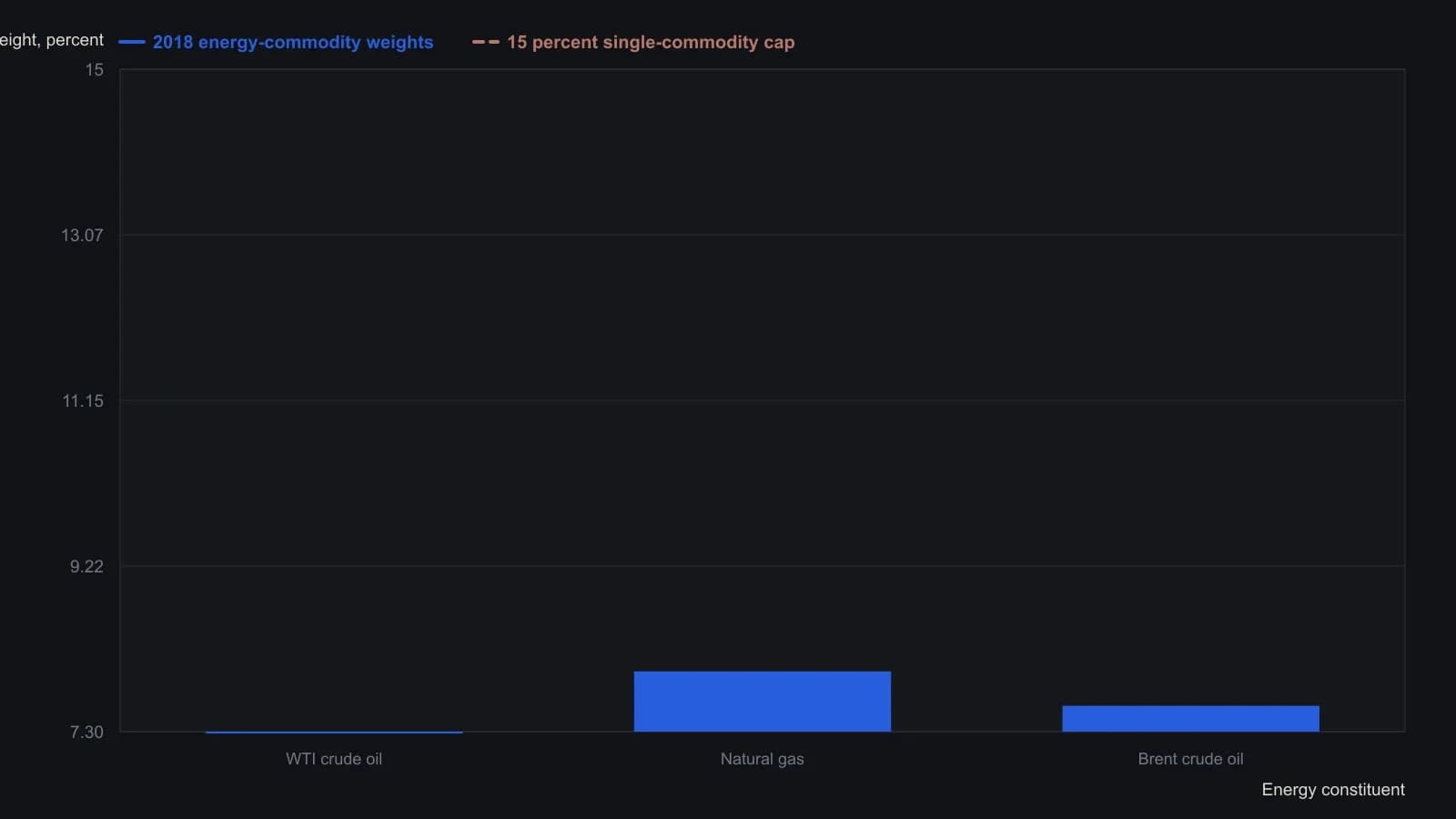
Natural gas is given as about 8 percent; WTI at 7.3 percent and Brent at 7.6 percent are stated exactly. RBOB gasoline and diesel complete the energy sleeve but no split was given, so they are omitted.
Whether posted margin is the size of the bet
At an index print of 89.0 the notional-contract-value was $8,900. Notional-contract-value is the index level times the contract multiplier, and it is the exposure being held. Listed posted-margin was under $250. Posted-margin is the cash required to carry the future, and it can be far smaller than notional. The same future could be held as a highly levered or a fully funded exposure.
Leverage-control is choosing how much of notional to fund so a planned cash loss stays bounded before and during the trade. A simplified dollar-risk sketch still had to allow for quarterly rolls, transaction costs, leftover contango, and no downside bound other than zero.
Editorial interpretation: TradersWeek treats funding as the third classroom decision. Using posted-margin as if it were the size of the bet confuses carrying cash with exposure.
All readings on this track · 9 readings
- 1990Building index futures fair value from cash-and-carry
- 2000Build a four-market commodity overlay for inflation regime context
- 2010Softs stocks-to-use and semiannual event windows
- 2012Contango and credit risk in listed commodity and volatility wrappers
- 2014A cheap-looking long in volatility-index futures is a classroom, not a fear hedge
- 2015A wide Treasury calendar and the 2015 delivery gap
- 2015A 2015 forced unwind is not a commodity-regime verdict
- 2017Contango, carry, and contract choice in equity-index volatility futures
- 2018One commodity-index future, three classroom decisions