2012issue C0745
Visible opening depth versus internalized subpenny priority
The first minute after the open is a check on whether advertised size can finish a residual order at the spread on the screen, and whether an internalizer then takes that turn from a displayed limit for a token subpenny.
- About a minute after the open, a 500-share IBM sale faced a 37-cent spread with only 100 shares shown on each side, so most of the order would have had to walk unknown depth.
- Other widely held names also opened with double-digit cent spreads, and inside a one-second window the quote can update many times as short-horizon liquidity providers post, improve by a penny, and cancel together.
- Marketable retail orders are often filled off-exchange by internalizers that pay for that flow, commonly citing subpenny improvement of one-hundredth of a cent while the displayed limit stays unfilled.
- From 10 October 2012, Canadian internalizers had to improve the protected quote by at least one cent, or by half a cent when the spread was already one cent, so a one-cent name could still print at a subpenny only at the midpoint.
An execution check after the open
TradersWeek editorial: treat the first minute after the open as an execution audit. Measure whether advertised size can finish the residual order at an acceptable spread, then ask whether internalized retail flow is taking that turn from a displayed limit for a token subpenny.
About a minute after the open, a 500-share IBM sale faced a 37-cent spread with only 100 shares shown on each side, so most of the order would have had to walk unknown depth.
Other widely held names also opened with double-digit cent spreads: 21 cents in PG after 19 seconds, 11 cents in KO within 30 seconds, and 25 cents in MMM after the open.
Quoted spreads in the first minute after the open
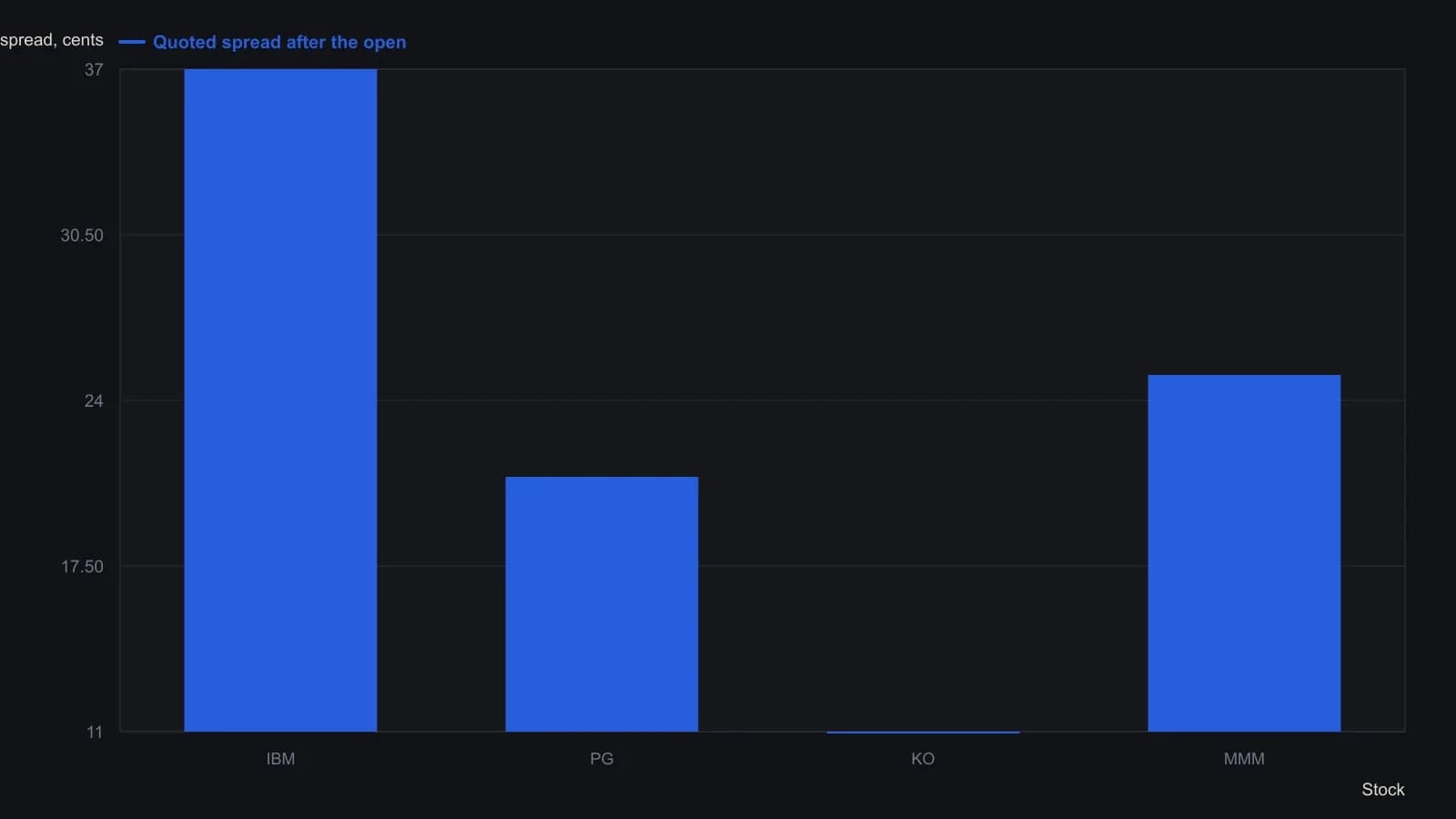
IBM was sampled about a minute after the open, PG at 19 seconds, KO within 30 seconds, and MMM after the open, so the bars are not a single synchronized snapshot.
Fleeting quotes inside a one-second window
Inside a one-second window the quote can update many times as short-horizon liquidity providers post, improve by a penny, and cancel together.
A fleeting quote is a bid or offer posted and cancelled inside the same short interval, so advertised size may not last long enough to trade. The trading increment is the official minimum price step. It is one cent for the names discussed here, except where a half-increment rule applies to a one-cent spread.
When retail flow never meets the displayed limit
A displayed limit is a public resting buy or sell that waits in the book for a marketable counterparty. Marketable retail orders are often executed off-exchange by internalizers that pay for that flow, so the orders never interact with a publicly displayed limit.
An internalizer is an off-exchange desk that purchases the right to trade against a broker's marketable retail orders instead of sending those orders to the public book. Payment for order flow is compensation paid to a broker for routing marketable retail orders to a chosen off-exchange counterparty.
The diverted fill is commonly justified with price improvement of one-hundredth of a cent, which still leaves the displayed limit unfilled. That concession is subpenny improvement: a fill priced a fraction of a cent inside the protected quote. The protected quote is the best publicly displayed bid and offer that an off-exchange fill is measured against.
TradersWeek editorial: after the size-and-spread check, ask whether internalized retail flow took the turn the displayed limit was waiting to receive.
The Canadian improvement floor
From 10 October 2012, Canadian internalizers had to improve the protected quote by at least one cent, or by half a cent when the spread was already one cent.
Under that Canadian rule, names already quoted a cent wide could still print at a subpenny, but only at the midpoint.
All readings on this track · 7 readings
- 2001Displayed size, venue rules, and execution costs
- 2004Opening auction envelopes and crutch pairs
- 2005Electronic index futures: spread quotes that follow the tape
- 2007Pairs, hedges, vanishing bids, and the cost of liquidity
- 2012A transaction levy makes one-tick market making unexecutable
- 2012Visible opening depth versus internalized subpenny priority
- 2012Broken quotes as liquidity events