1991issue C021-10
Testing dealer inventory caps against a frozen order tape
Treat the dealer as three switches: a tick-offset-fill, an inventory-cap, and which ticket sizes still receive a quote after that cap. Holding a frozen-order-tape fixed then shows when depth is absorbed, when it sits in a booked-slot, and when on-balance-volume diverges from price.
- A tick-offset-fill lifts every buy one increment above the last price and hits every sell one increment below it, and ticket size does not change that treatment.
- A frozen-order-tape of 4,000 predetermined tickets lets inventory-cap variants be compared on identical flow, because later demand cannot react to the prices those rules produce.
- Order-concentration, not the size of any one ticket, drives the quote, so many small same-side prints can outweigh a single larger opposing print.
- A soft-limit that still absorbs tickets of 1,000 shares or fewer is presented as keeping the tape more orderly than a stand-aside, and the preferred procedure is to keep quoting rather than step away.
Three switches for one dealer
The historical workflow treats the dealer as a three-switch procedure. The first switch is a tick-offset-fill: every incoming buy is filled one increment above the last price and every incoming sell one increment below it. Ticket size does not change that treatment. The second switch is an inventory-cap, hard or soft, after which the dealer stops absorbing the next ticket. The third switch is which ticket sizes still receive a quote after that cap.
A frozen-order-tape and a balanced session
A session is defined as 20 transactions. A draw on the closed interval from -1.0 to +1.0 sets side by sign and size by magnitude, so the long-run buy-to-sell count is constructed to approach one.
A reusable tape of 4,000 predetermined tickets is held fixed so alternative inventory rules can be compared on identical flow. Later demand cannot react to the prices those rules produce. The size mix is calibrated to about 18,500 shares per session, a small-to-large ratio of 0.72, and 58.4 percent of volume in lots larger than 1,000 shares.
Order-concentration and the unconstrained run
In this construction the quote is driven by how tightly same-side tickets cluster, not by the size of any one ticket. Many small buys can outweigh a single large sell. That pattern is order-concentration.
On the unconstrained run the quote reaches 22.25 while inventory is short 99,900 shares. The stated long-run dealer edge is collecting the spread provided cash is not exhausted before sides rebalance.
A hard inventory-cap, booked-slots, and stand-aside
At a 50,000-share hard inventory-cap the dealer raises or lowers the quote without printing, queues the unfilled ticket, and gives later same-side interest precedence. A large opposing ticket can then clear several booked-slots before the quote steps back.
A stand-aside at 50,000 shares lets the quote run and leaves the remaining inventory marked poorly when it is later covered. The write-up treats that path as a consequence of the rule set, not as a live-market finding.
A soft-limit and which sizes still receive a quote
Raising the stop to 60,000 shares and still absorbing tickets of 1,000 shares or fewer, while booking larger size, is presented as keeping the tape more orderly than a rigid stand-aside. That rule is a soft-limit.
Across capped variants, taking only the smallest lots is called ineffective. Accepting sizes through 500 shares minimizes a defined exposure product of peak short inventory times peak price. On a second tape the 60,000-share inventory-cap is touched only once. A later price advance that outruns on-balance-volume is read as many small buys mixed with a few large sells. The preferred procedure is to keep quoting rather than step away.
Ending specialist P&L under five inventory-cap rules
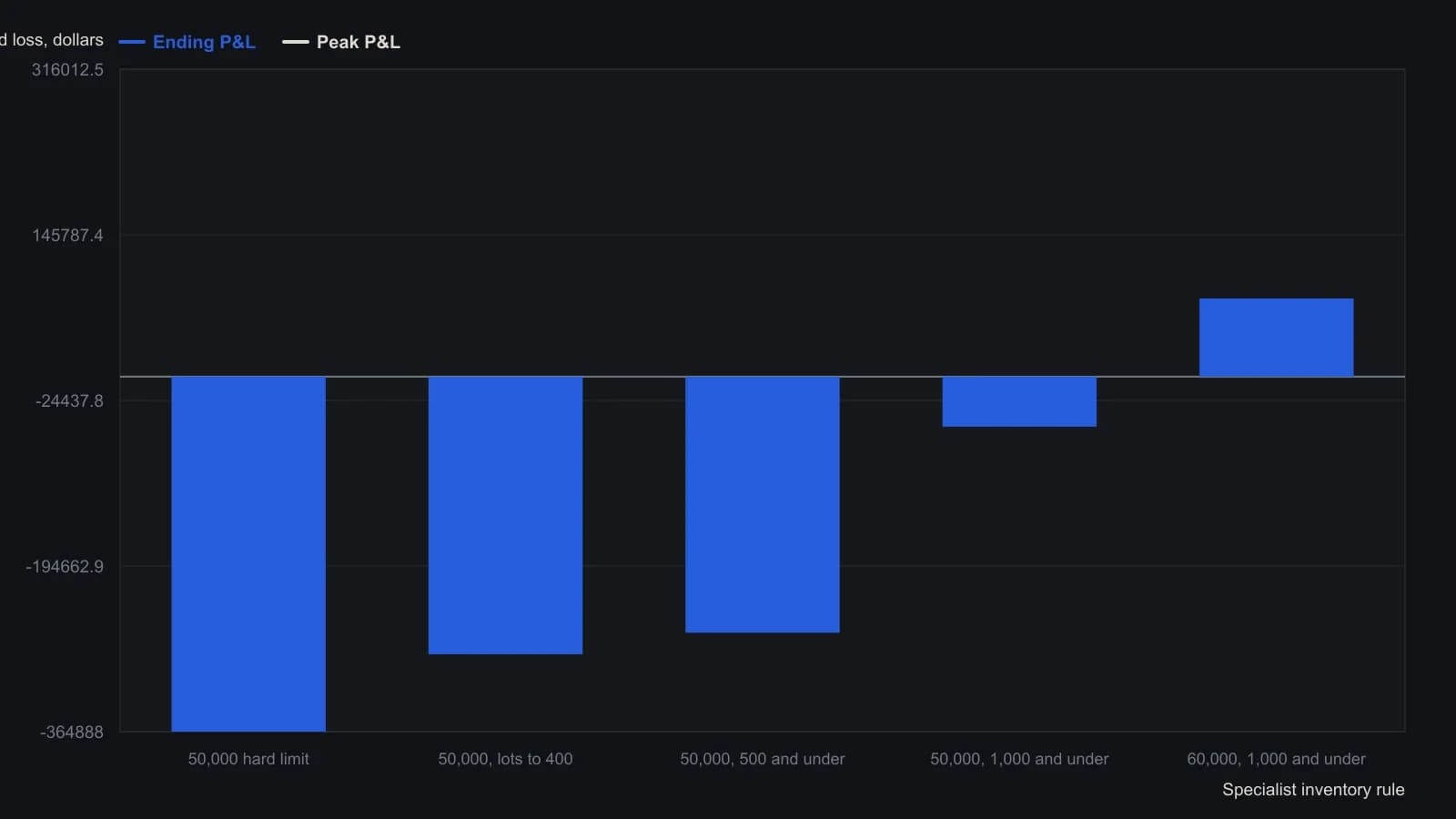
Order flow is fixed in advance, so price cannot feed back into the tape. Strategies 1–4 share a 50,000-share inventory line; strategy 5 lifts it to 60,000 and still fills tickets of 1,000 shares or fewer after the line is hit. Peak P&L is identical on the first four rules because they share the same early long-side run.
All readings on this track · 7 readings
- 1991Testing dealer inventory caps against a frozen order tape
- 2003Cheaper access still left a routing and cost problem
- 2006Order-book depth and passive flow for execution
- 2008Depth, close imbalances, and pairs on one clock
- 2012Checklist exits and the limits of visible book depth
- 2013Constructing forex orders from provider imbalance and book depth
- 2017Ladder, trail, and average as one execution ticket