1989issue C061-5
Treasury auction-rollover as yield-to-price series construction
A newly auctioned Treasury issue has no price history for trend or momentum tools, and its quoted price usually differs from the prior issue because coupon and maturity change. Three construction routes are offered for keeping a continuous file through auction: a perpetual-price-series splice, price-index-weighting, or a yield file that can be converted into theoretical prices of the new coupon.
- A newly auctioned Treasury issue has no price history for trend or momentum tools, and its quoted price usually differs from the prior issue because coupon and maturity change.
- A perpetual-price-series splice can inject a data-shock: averages and oscillators jump when coupon and maturity change, not when the market moves.
- Price-index-weighting subtracts the auction-day spread so the new issue sits on a chosen base level, but the readings no longer describe the live auctioned bond and the weights become cumbersome to maintain.
- A yield file under a yield-parity-handoff can take the new issue without a price-level shock; theoretical-price-conversion then lets the live bond's actual high, low, and close sit on a continuous moving-average and stochastic backbone.
Auction-rollover starts without a price history
A newly auctioned Treasury issue has no price history for trend or momentum tools, and its quoted price usually differs from the prior issue because coupon and maturity change.
Auction-rollover replaces the prior bellwether with the newly auctioned issue so charts and indicators continue without a gap.
Three construction routes
Three construction routes are offered for keeping a continuous file through auction: splice the new issue into a perpetual-price-series, build a weighted price index, or maintain yields instead of prices.
A perpetual-price-series injects a data-shock
On 12 and 13 May 1988, replacing the 8.875% August 2017 bellwether with the 9.125% May 2018 issue lifted the close from 96.4375 to 100.21875 and moved an 18-day moving average from 97.7344 to 97.8490 because coupon and maturity changed, not because the market moved.
The same perpetual-price-series splice moved a 5-day relative-strength reading from 18.4788 to 81.7381, crossing from an oversold zone to an overbought zone without a corresponding market move.
Bellwether long-bond prices through the May 1988 auction
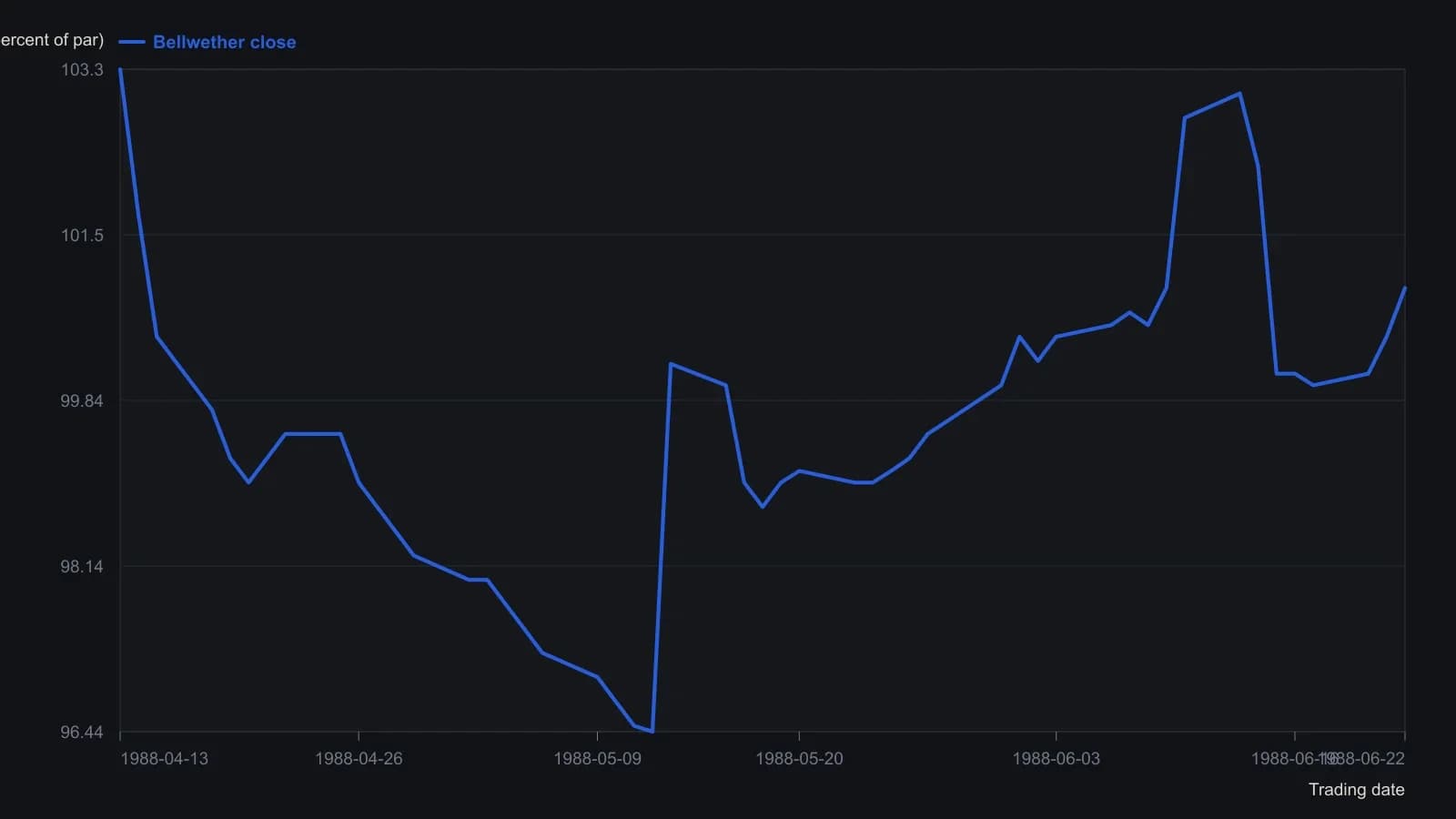
Raster is inverted (lower printed prices at the top of the frame). Daily closes were read from the curve against the printed 98–104 grid; the article’s stated 12 May close of 96.4375 and 13 May close of 100.21875 were used as anchors. Dates are trading-day estimates across the printed window 13 April–22 June 1988. Digitized levels are approximate to about 1/8 point.
Price-index-weighting leaves the live bond behind
Indexing subtracts the auction-day spread between a chosen base bond and the new issue, illustrated as 3.2187 points or 103/32nds, to create a synthetic series. Trend and momentum readings can be computed, but they no longer describe the live auctioned bond and the weights become cumbersome to maintain.
Yield-parity-handoff and theoretical-price-conversion
A yield file can accept the new issue at auction without the price-level shock if the when-issued bond trades near yield parity with the old issue. Yield-based moving-average and oscillator signals invert relative to price. That mirror is signal-inversion: an oversold yield reading corresponds to an overbought price condition, and the reverse.
Converting the stored yield history into theoretical prices of the newly auctioned coupon and maturity lets the new bond's actual high, low, and close be plotted immediately against multi-horizon moving averages and a stochastic oscillator.
Converted indicators diverged mainly at the splice
The construction example applies 4-, 18-, and 100-day moving averages with a 21-day stochastic oscillator and a 14-day relative-strength reading on the converted prices, and those converted indicators diverged from raw-price indicators mainly at the 13 May auction splice.
All readings on this track · 8 readings
- 1989Treasury auction-rollover as yield-to-price series construction
- 1991Calendar spread execution for futures month rolls
- 1992Converting OHLC, session, and rollover series for analysis
- 1992Linked futures series for mechanical system evaluation
- 1998Percentage back-adjusted futures series
- 2001Construct a volume-weighted continuous-lead contract
- 2013Construct a continuous futures series from the roll you can execute
- 2018Commodity-basket exposure as a contract-design problem