2013issue C0744-51
Construct a continuous futures series from the roll you can execute
A continuous futures series is a construction choice: the roll trigger and the stitch method decide whether the history you test matches a rollover you can actually place. Open-interest is the stronger default trigger, and the choice among nth-nearest, back-adjusted, and detrended stitches decides whether delivery gaps or unusable prices appear.
- A continuous futures series can be rolled when the next contract's open-interest exceeds the front contract's, or when it exceeds a chosen percentage of that open-interest.
- Volume is a weaker default roll trigger than open-interest because volume can spike and produce false rollovers, including a backward step unless generate-forward is turned off.
- An nth-nearest series can show price gaps at delivery dates, while a back-adjusted series built from the close-to-close difference at the roll does not.
- If back-adjusted prices turn negative, or an open-interest roll fires too late, detrending or edited expiration-date rules can keep the series usable.
Roll trigger and stitch are construction choices
A continuous futures series is assembled from successive expiries. Rollover-management is the choice of when and how to leave an expiring futures contract and enter the next one so the trade remains executable. Futures-contract-selection is the choice of which expiry to hold and how to stitch those expiries into one continuous series for analysis.
Open-interest-analysis uses outstanding contract counts, rather than volume spikes, to decide when liquidity has moved to the next expiry. In this workflow, that outstanding count is how the roll is timed.
Use open-interest, not volume, to time the roll
A continuous futures series can be rolled when the next contract's open-interest exceeds the front contract's, or when it exceeds a chosen percentage of that open-interest.
Volume is a weaker default roll trigger than open-interest because volume can spike and produce false rollovers. A false volume roll can include a backward step unless the generate-forward option is turned off.
Nth-nearest gaps and back-adjusted stitches
An nth-nearest continuous series is built by always using the contract nearest in the expiry stack, then jumping to the next when a roll rule fires. That series can show price gaps at delivery dates.
A back-adjusted series adds the price difference at the roll to earlier contracts so the chart does not show a gap at delivery. Built from the close-to-close difference at the roll, the back-adjusted series does not show those delivery gaps.
Nth-nearest versus back-adjusted soybean continuous contracts
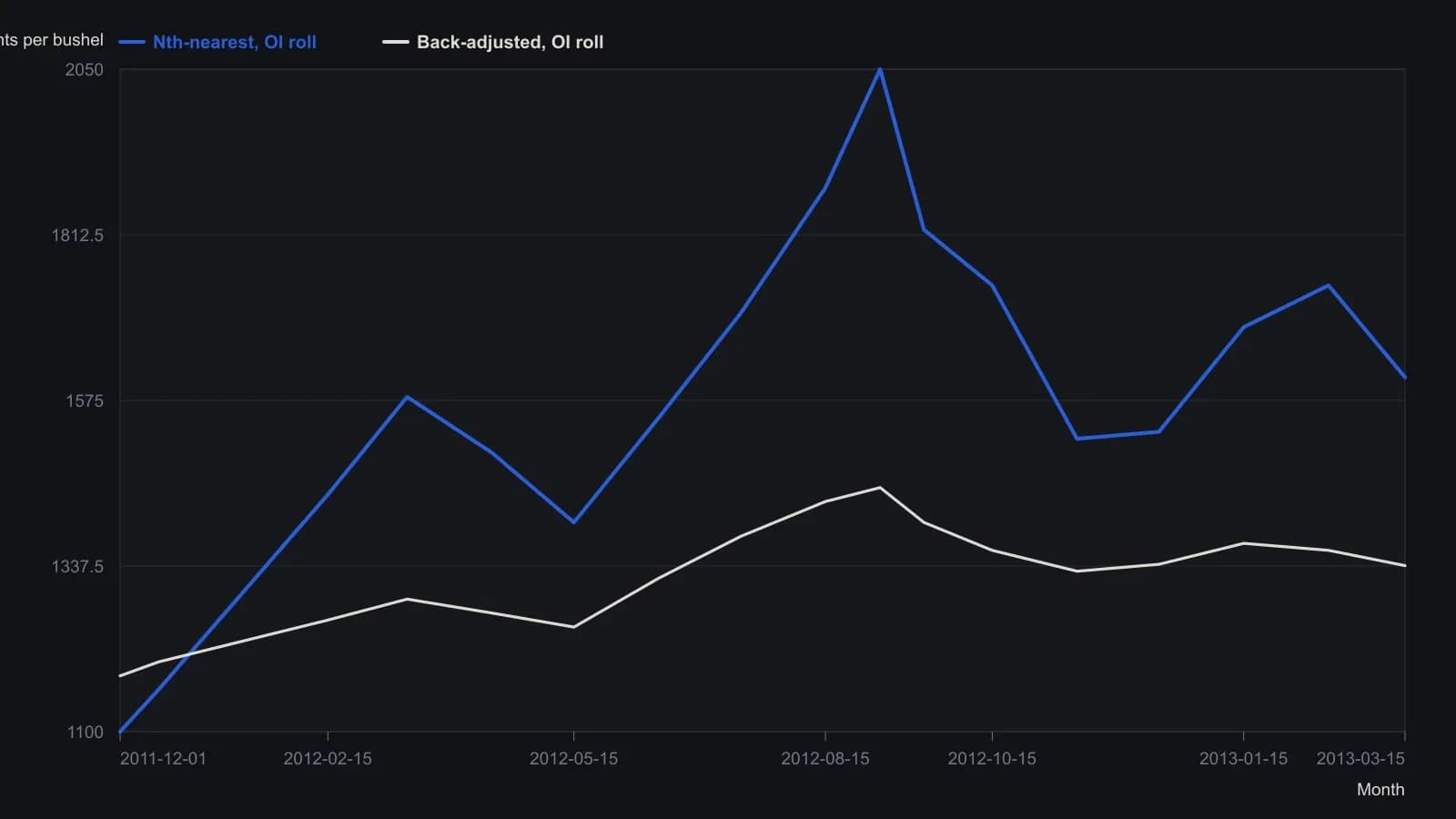
Both series use open interest as the roll trigger. The source plotted second-nearest on a left scale of about 1000–2100 and back-adjusted on a right scale of about 1100–1600; values are those native readings, approximate to the nearest 10 cents except the two last quotes printed on the chart. Roll gaps at the yellow delivery markers are near the resolution of the screenshot, so gap size was not forced. Volume and open interest in the lower pane were not digitized.
When the stitch becomes unusable
Detrending estimates the slope from the current contract back to an earlier contract and can be applied when a back-adjusted commodity series would otherwise become unusable.
If an open-interest roll fires too late, expiration-date rules can be edited instead, including calendar dates and added expiry conditions.
All readings on this track · 8 readings
- 1989Treasury auction-rollover as yield-to-price series construction
- 1991Calendar spread execution for futures month rolls
- 1992Converting OHLC, session, and rollover series for analysis
- 1992Linked futures series for mechanical system evaluation
- 1998Percentage back-adjusted futures series
- 2001Construct a volume-weighted continuous-lead contract
- 2013Construct a continuous futures series from the roll you can execute
- 2018Commodity-basket exposure as a contract-design problem