2013issue C1042-44
Constructing forex orders from provider imbalance and book depth
A 2013 execution display listed visible forex liquidity providers, signed each net inside tilt, and placed size by distance from the inside quote. TradersWeek reads that book as a three-part filter so the order, and its implementation cost, is built before any directional bet.
- An execution display can list visible forex liquidity providers and indicate whether each is buying or selling a chosen currency pair.
- Cumulative inside-bid and inside-ask shares sit beside a signed net imbalance, while a depth view places each provider’s size by distance from the inside quote.
- Quote activity can be scored on a session-long total and on a recent window the user can set from one to 30 minutes.
- An anonymous provider identifier can be followed through time to see a change of direction and whether later inside-quote activity follows through.
What the execution display showed
A 2013 description of the currency market placed daily turnover near five trillion dollars and treated large financial institutions as the dominant participants.
An execution display can list visible forex liquidity providers and indicate whether each provider is buying or selling a chosen currency pair. The inside quote, the best bid and best ask currently shown, is the reference point for imbalance, depth, and recency on that display.
Who is leaning at the touch
For each provider, cumulative inside-bid and inside-ask shares can sit beside a net bid/ask imbalance whose sign is highlighted as positive or negative.
That net figure is order-book imbalance: the net tilt between a liquidity provider’s inside bid and inside ask, used as a filter on whether the visible book is leaning to buy or to sell.
Sorting providers by session activity identifies who has quoted most, while scanning the net-imbalance column identifies who currently shows the largest bid/ask tilt.
EURUSD liquidity-provider net imbalance at the inside quote
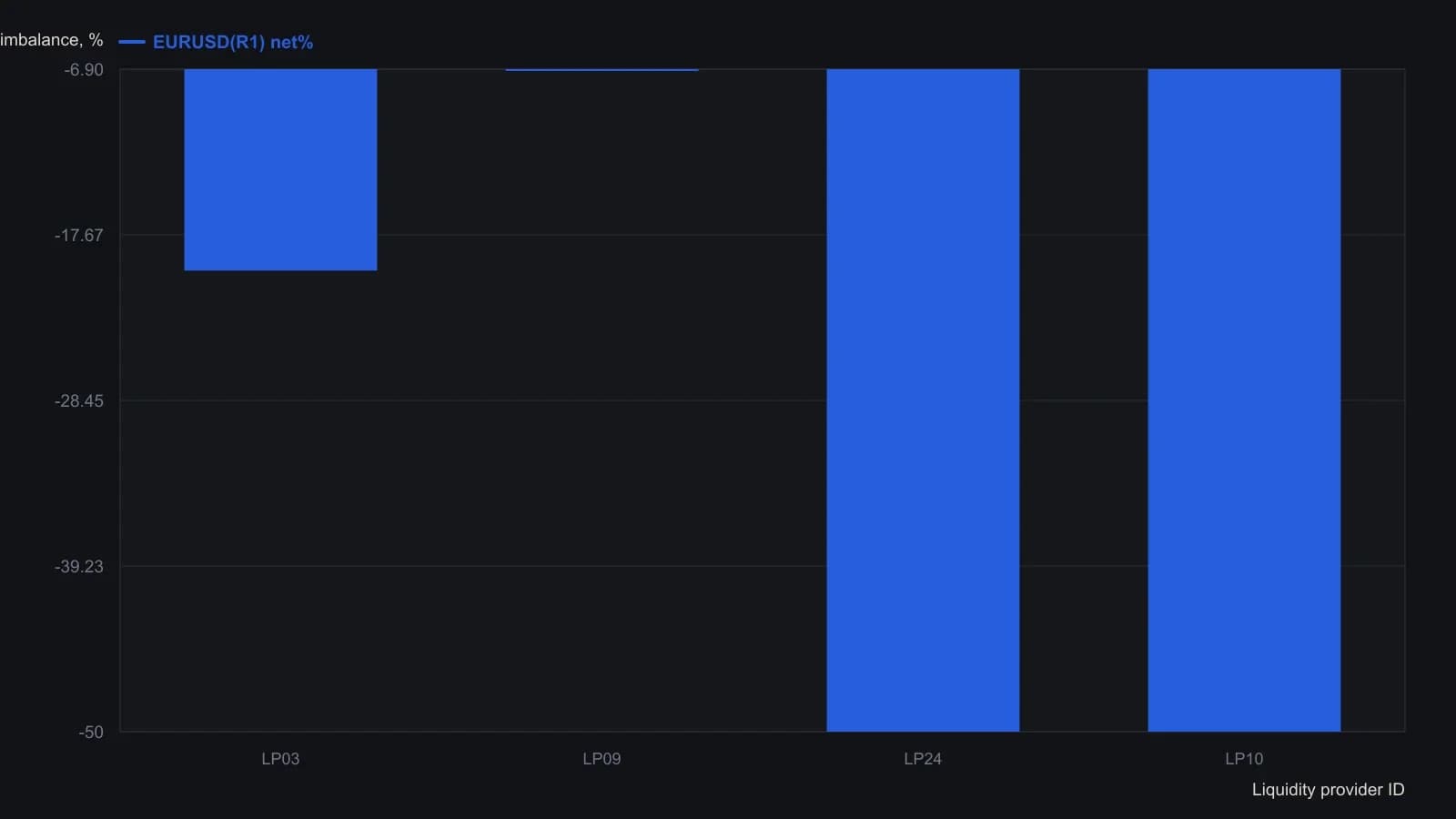
Net% is the bid/ask imbalance as shown on the montage; a positive reading is a bid lean and a negative reading is an ask lean. Session total% is the provider’s share of inside activity for the whole session, not the 1–30 minute recency window.
How far size sits from the touch
A depth view can place each provider’s bids and asks relative to the inside quote so a trader can see how far size sits from the touch.
That placement is order-book depth: each provider’s bids and asks by distance from the inside quote, used to judge whether size is available at the touch or only away from it.
Whether a short window confirms the lean
Provider quote activity can be computed on two clocks at once: a session-long total and a recent window the user can set from one to 30 minutes. Session-versus-recent keeps a full-session activity score beside that short lookback for the current lean.
Each liquidity provider can be followed through an anonymous unique identifier even when the institution behind that identifier is not named. The liquidity-provider id is that anonymous tag: it lets one institution’s quote activity be tracked across a session without naming the firm.
Watching a provider identifier over time can show when that provider changes direction and whether later inside-quote activity follows through on the change. Order-flow analysis, in this construction, is that follow-through check.
From the three panes to the order
TradersWeek editorial reading: sort first by who has quoted most on the session clock, then scan the net-imbalance column for the largest current tilt. Open the depth view to see whether that tilt is sitting at the inside quote or only away from it. Check the recent window to see if the lean is still printing. Follow the liquidity-provider id when a provider changes direction, and ask whether later inside-quote activity follows through before the order is sent.
The output of that pass is a filter on the order itself. Choose an executable order and account for implementation cost. Any directional bet comes after that filter, not before it.
All readings on this track · 7 readings
- 1991Testing dealer inventory caps against a frozen order tape
- 2003Cheaper access still left a routing and cost problem
- 2006Order-book depth and passive flow for execution
- 2008Depth, close imbalances, and pairs on one clock
- 2012Checklist exits and the limits of visible book depth
- 2013Constructing forex orders from provider imbalance and book depth
- 2017Ladder, trail, and average as one execution ticket