2012issue C0132-36
Forex arbitrage is usually correlation, not riskless profit
Quoted FX rates can differ across banks and liquidity pools, but leftover gaps are a doubtful harvest. Many setups labeled as arbitrage are pairs or correlation systems that still need entry, exit, and abstention rules.
- Forex is an OTC spot market, so quotes can differ across banks and liquidity pools instead of sharing one exchange print.
- Faster quotes and pricing algorithms can shrink those gaps to milliseconds, which makes leftover discrepancies a doubtful source of harvestable profit.
- Banks mainly make markets and earn volume markups, so the absence of obvious bank-scale arbitrage is not proof of an unused riskless edge.
- Many setups labeled forex arbitrage are mean-reversion correlations or pairs relationships and should be tested as signal systems, not described as riskless.
When arbitrage is only a name
The archive described many setups labeled forex arbitrage as mean-reversion correlations or pairs relationships. Those setups can still be tested as signal systems. They should not be described as riskless arbitrage.
Forex is an OTC spot market, so quoted rates can differ across banks and liquidity pools rather than sharing a single exchange print. That is the market-structure setting for Intermarket and spreads work.
Several quotes can be the market
Interbank examples can show distinct pairwise rates of 1.3866, 1.3863, and 1.3864 whose intersection is treated as the market price. The archive used that picture to illustrate a multi-ECN network rather than one exchange price with only buyers and sellers.
A large client order, such as selling 100 million EUR/USD, may be worked across counterparties at different prices and returned as an average fill. Any off-market print can be absorbed into wholesale price discovery instead of standing as a clean arbitrage ticket.
Pairwise EUR/USD quotes across three banks
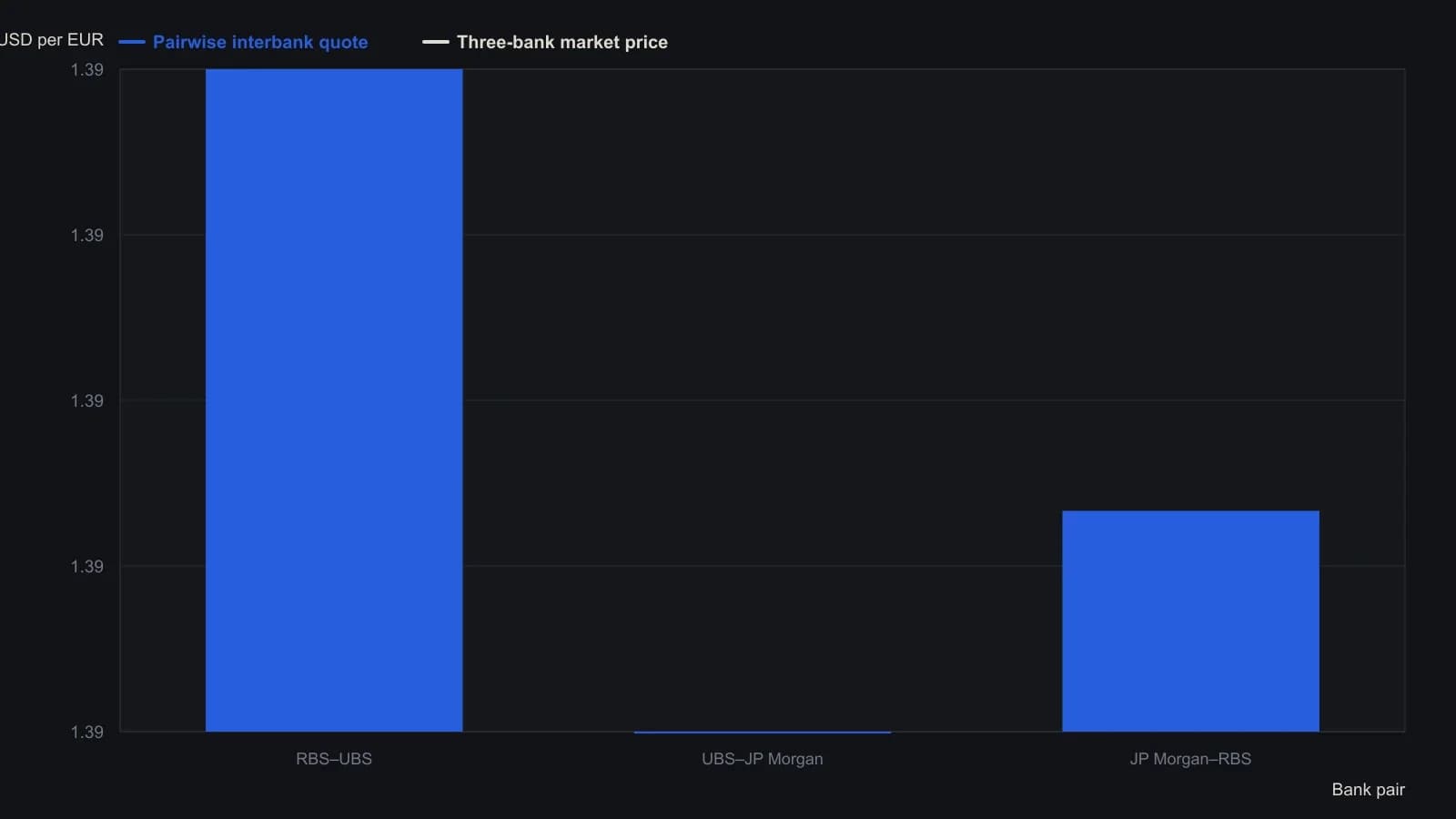
The source treats each pairwise quote as a simple average of two bank prices and the market print as the average of the three; it notes that live algorithms also fold in volume and the spread.
Leftover gaps are a doubtful harvest
Faster quotes and pricing algorithms can shrink those pool-to-pool gaps to milliseconds. The archive treated it as doubtful that the leftover discrepancies are large or durable enough to harvest as profit.
Banks mainly make markets and fill clients rather than run proprietary FX books. The absence of obvious bank-scale arbitrage is not proof that a riskless edge is sitting unused.
Retail and small-client FX spreads can reach about 1% of the transaction. That gives banks a volume-based markup business and reduces the incentive to fund high-risk proprietary arbitrage systems.
Pairs and correlation, not unused profit
Capturing documented FX discrepancies is framed as requiring substantial time, capital, programming, and trading experience. Less-resourced traders are steered toward correlation strategies instead of true arbitrage.
Editorial: Correlation analysis is the fitting label when the relationship is a mean-reversion or pairs link. Keep Arbitrage trading for claims that do not still depend on ordinary signal rules.
All readings on this track · 5 readings
- 2002Selecting the single-stock future as the short-sale switch
- 2004Constructing the cash open from futures fair value
- 2007Option arbitrage as a six-layout construction problem
- 2008Opening auction, market making, and arbitrage as a capital business
- 2012Forex arbitrage is usually correlation, not riskless profit