2004issue C071-4
Constructing the cash open from futures fair value
Treat the first cash print as a stack of the overnight index-proxy quote, a once-a-day carry-implied fair-value spread and a program-band, then reduce the implied gap because the same basket-versus-futures routines move futures back toward cash as they fire.
- Futures minus cash is a premium when positive and a discount when negative, and that live spread is read against a carry-implied fair-value gap rather than against a zero difference.
- Fair-value is built once a day from the cash index, a short-term interest rate, remaining time to expiration and expected basket dividends, then held fixed while the overnight futures print updates the opening-gap-estimate.
- A buy-program or sell-program is described as starting only when the deviation from fair-value is material, generally 0.70 to 0.90 points.
- The cash opening gap is not expected to match the raw residual, because programs that lift cheap futures or press rich futures shrink the spread before the opening print finishes.
Three layers, not a headline call
The cash market in this workflow is a capitalization-weighted equity index, and the listed futures are a later-dated contract on that same index value. While the cash session is closed, the listed futures price is the index-proxy: a stand-in for the cash equity index.
Editorial reading: treat the first cash print as a three-layer reconstruction rather than a headline call. Stack the overnight index-proxy quote, the once-a-day carry-implied fair-value spread and the program-band. Then allow for gap-shrinkage, because the same basket-versus-futures routines move futures back toward cash as they fire.
Futures can keep trading after the cash close while the stocks are quiet, so overnight news can leave the opening futures-cash gap far from fair-value.
Premium, discount and fair value
Subtracting the cash-index level from the futures price yields the live spread. That futures-minus-cash difference is the premium-discount: a premium when the difference is positive and a discount when it is negative. Quotes of 844.0 versus 840 produce a 4.00-point premium.
Fair-value is the carry-implied futures level obtained by growing the cash index at the financing rate over remaining tenor and subtracting expected basket dividends. Using cash 840, a 3 percent rate, 3.5 of dividends and 75 days remaining (0.2055 year) produces a fair-value futures level of 841.6, equivalent to a 1.6-point carry gap versus cash.
When the live premium exceeds that carry gap, futures are treated as rich and the described arbitrage buys the cash basket while selling futures. When futures are cheap versus fair-value, the legs reverse.
The program band
Programs are described as starting only when the deviation from fair-value is material, generally 0.70 to 0.90 points. That extra deviation is the program-band.
A buy-program sells rich futures against a purchase of the cash basket when the premium exceeds fair-value by the program-band. A sell-program buys cheap futures against a sale of the cash basket when the discount exceeds fair-value by the program-band.
One five-minute cash chart is described as dropping 2.5 points in the first minutes as those programs printed.
Building the opening-gap estimate
The fair-value offset is treated as a once-a-day input that does not change during the session. The opening-gap-estimate therefore updates through the overnight futures print versus the prior cash close. It sketches the direction and scale of the cash opening print from prior-close cash, the overnight futures print and that fixed offset.
A worked open used overnight futures 1147.70, a prior futures close of 1154.20, a prior cash close of 1154.87 and a 0.47 fair-value offset to imply about a 6.97-point downside cash gap.
Why the implied gap shrinks
That construction does not expect the cash opening gap to equal the raw residual, because programs that buy cheap futures lift the futures and shrink the spread. Gap-shrinkage is that reduction of the implied cash gap: programs that lift cheap futures or press rich futures close part of the spread before the opening print finishes.
The same session's cash index is described as opening 5.5 points lower.
March 5 2004 cash-open gap stacked from GLOBEX and fair value
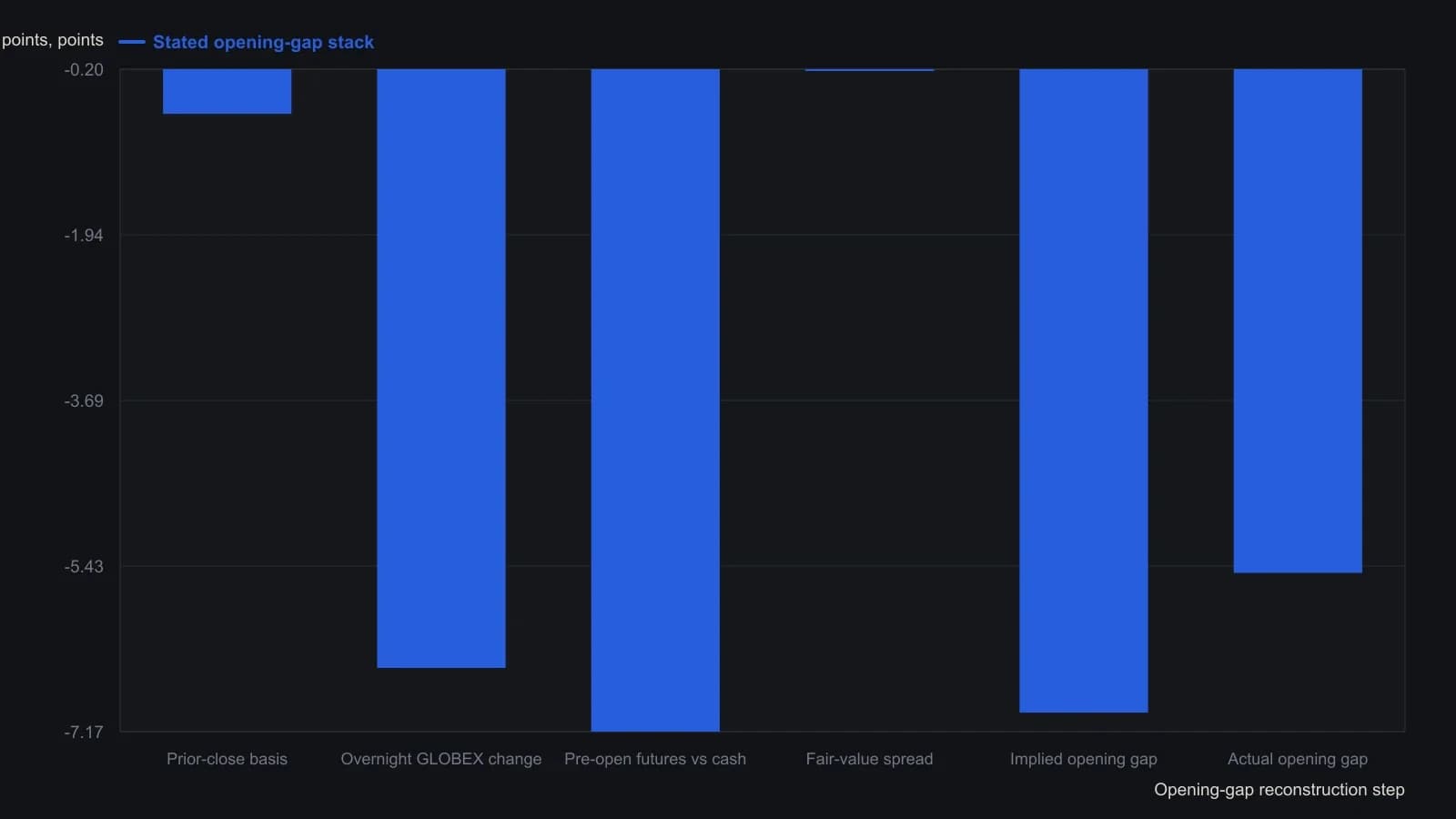
Fair value is the 0.47 CNBC print added to the prior-close basis of −0.67, as the article computes. The 0.70–0.90 program band is why the author would not expect the full 6.97-point gap.
All readings on this track · 5 readings
- 2002Selecting the single-stock future as the short-sale switch
- 2004Constructing the cash open from futures fair value
- 2007Option arbitrage as a six-layout construction problem
- 2008Opening auction, market making, and arbitrage as a capital business
- 2012Forex arbitrage is usually correlation, not riskless profit