2016issue C0122-25
A forecast is a hypothesis, not a sizing license
Selecting a present setup with an acceptable risk-to-reward profile is a different job from scoring a later outcome. A confident call still has to pass risk-of-ruin, expected-value, and a review of the live paths that would invalidate it.
- A present-opportunity is judged by whether loss and reward are acceptable now. An outcome-dependent-forecast is scored only after one path is realized.
- Confidence in a preferred outcome spotlights how the position can win and underweights the many ways exposure can fail.
- Premortem-sizing and scenario-risk-analysis set size for the path that invalidates the call and mark where belief and exposure should reverse.
- A concentrated-wager kept on to defend a forecast is a risk-of-ruin problem. Pair the call with risk limits instead of using it to overexpose the account.
Forecasting is scored later
Selecting a present-opportunity with an acceptable risk-to-reward profile is a different job from forecasting. An outcome-dependent-forecast is scored by whether a predicted outcome later occurs, not by how convincing the setup looks now.
A completed chart can make one path look inevitable even though several credible paths were available from the same point in real time.
Confidence spotlights the winning path
Confidence in a preferred market outcome tends to spotlight how the position can win and underweight the many ways that exposure can fail.
Fresh evidence should raise or lower belief in a proposed outcome. Defending the original call after contradictory data arrive is the opposite process. An invalidation-update uses obvious failures of the preferred path as a reason to cut belief and exposure rather than as noise to ignore.
Risk control is more than a stop
Risk control is described as more than placing a stop. It includes identifying, assessing, controlling, measuring, and monitoring exposure.
The wish to avoid a realized loss can keep a failing forecast funded. Refusing to accept a bounded loss is treated as futile. Staying in a losing position to protect a forecast is presented as a fast route out of the business, and overreliance on the call is one reason that size stays on.
Review the ways the idea can fail
A pre-trade review of how the idea can fail is presented as a reason to cut size or leverage and to mark where bias and exposure should reverse. That premortem-sizing step names those flip levels before the order is sent.
Scenario-risk-analysis is a structured look at competing live paths from the same point so exposure is set for the path that invalidates the call, not only the path that confirms it. Expected-value is a pre-trade filter that counts failure paths, payoff, and size together instead of scoring only the hoped-for outcome.
Risk-of-ruin is the chance that an oversized loss or a string of defended losses ends the account. It is used as a filter that must be bounded before entry and while the position is open.
One story is not one safe wager
A concentrated-wager can become a single concentrated loss because paths rarely unfold in a straight line. Multiple smaller exposures are offered as the alternative that keeps downside bounded.
Well-argued higher and lower views can be live at once, and only one path is realized, so a forecast is to be paired with risk limits rather than used as a reason to overexpose the account.
EUR/USD weekly path inside a descending channel, 2006–2016
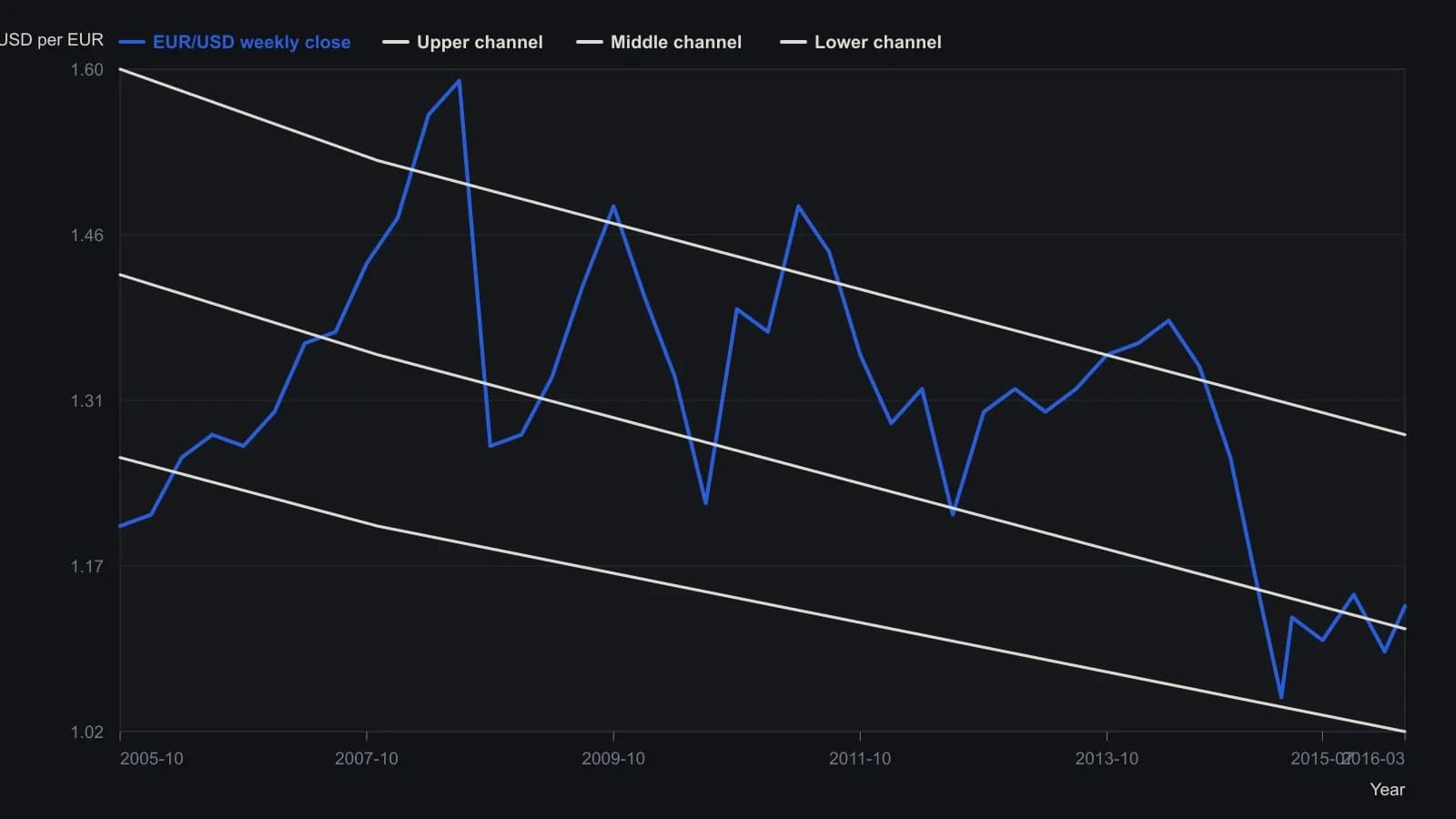
About 50 weekly-scale points read off the raster; y-values are approximate to roughly 0.01–0.02 EUR per USD. Channel rails are supporting references, not traded levels from a table. The 1.000 line is the parity outcome named in the figure notes.
All readings on this track · 15 readings
- 1985Event-class hazards and pre-trade survival checks
- 1985Exchange controls that close the trading-window
- 1989Scenario-checked short-call income versus directional premium
- 2003American cash-settled debit spreads run on two clocks
- 2006Trading survival as a precommitted decision process
- 2006Storm season, futures weather regimes, and contract size
- 2007Country and sector sleeves as a construction choice
- 2008Weather regimes and agricultural markets: a 2007-2008 case study
- 2010Grain price regimes start with the crop cycle, the dollar, and leftover inventories
- 2015Convert year-ahead forecasts into if-then checklists
- 2016A forecast is a hypothesis, not a sizing license
- 2016The commodity hold-forever thesis fails drawdown and ruin screens
- 2020Forecast safety after rare market shocks
- 2020Reserve-currency regime, productivity shocks, and scenario filters
- 2020Handing a futures account to a manager is still a ruin problem