2002issue C101-3
When fifth-impulse rules end a bull too soon
Editorial reading: turn a finished fifth-wave label into a critique drill. Test the candidate impulse-wave against the prior third wave on length and accompanying growth, and mark the count failed if a shorter-than-three rule would have forced an exit years before the actual peak.
- Elliott-wave practice reads price as waves and counterwaves, commonly grouped in fives, to interpret market structure.
- A 1982-2000 secular advance, sometimes dated from a 1975 low, was labeled a fifth and final impulse-wave after the early-1930s crash.
- Rigid use of the fifth-wave-length-rule expected that advance to end years before the eventual peak, including top calls around 1997 and 1998.
- Editorial reading marks a finished fifth failed if a shorter-than-three rule would have forced an exit years before the actual peak.
Waves, counterwaves, and a finished fifth
Elliott-wave practice is introduced as reading price into waves and counterwaves, commonly grouped in fives, to interpret market structure. In that workflow, an impulse-wave is the directional five-wave advance or decline counted as the trend-defining leg of a larger-degree structure, and a corrective-wave is a countertrend retracement of an impulse that is not treated as a new trend leg until the larger count confirms.
Wave-degree is the timescale of a labeled move, from an intraday swing to a multi-decade secular leg. A finished fifth-wave label therefore sits inside a larger count. Editorial reading turns that finished label into a critique drill rather than a closed conclusion.
A fifth impulse after the early-1930s crash
A 1982-2000 secular advance was labeled a fifth and final impulse-wave in a long sequence after the early-1930s crash. That secular bull was sometimes dated from a 1975 low.
The long-horizon case rested on a five-wave pattern read on a major industrial average from the 1930s forward, not only on late-1990s deflation symptoms.
Length and accompanying growth
That fifth-wave advance was compared with a 1942-66 third-wave advance. Later-wave equity magnitude was judged larger, while growth, industrial production, and capacity use were weaker and unemployment and debt burdens were higher.
Folding economic and cultural context into the wave count was treated as essential to a summit-reached thesis. That step is a fundamental-overlay: economic or cultural context folded into a wave count to argue that a late-stage impulse is exhausting. The same overlay can distract a trader who wants only a chart signal.
A late-impulse deflation overlay argued that a rising currency increases the real burden of earlier leverage. One cited 1996-2000 episode had the dollar index up more than 35 percent.
DJIA five-wave advance from the 1932 low
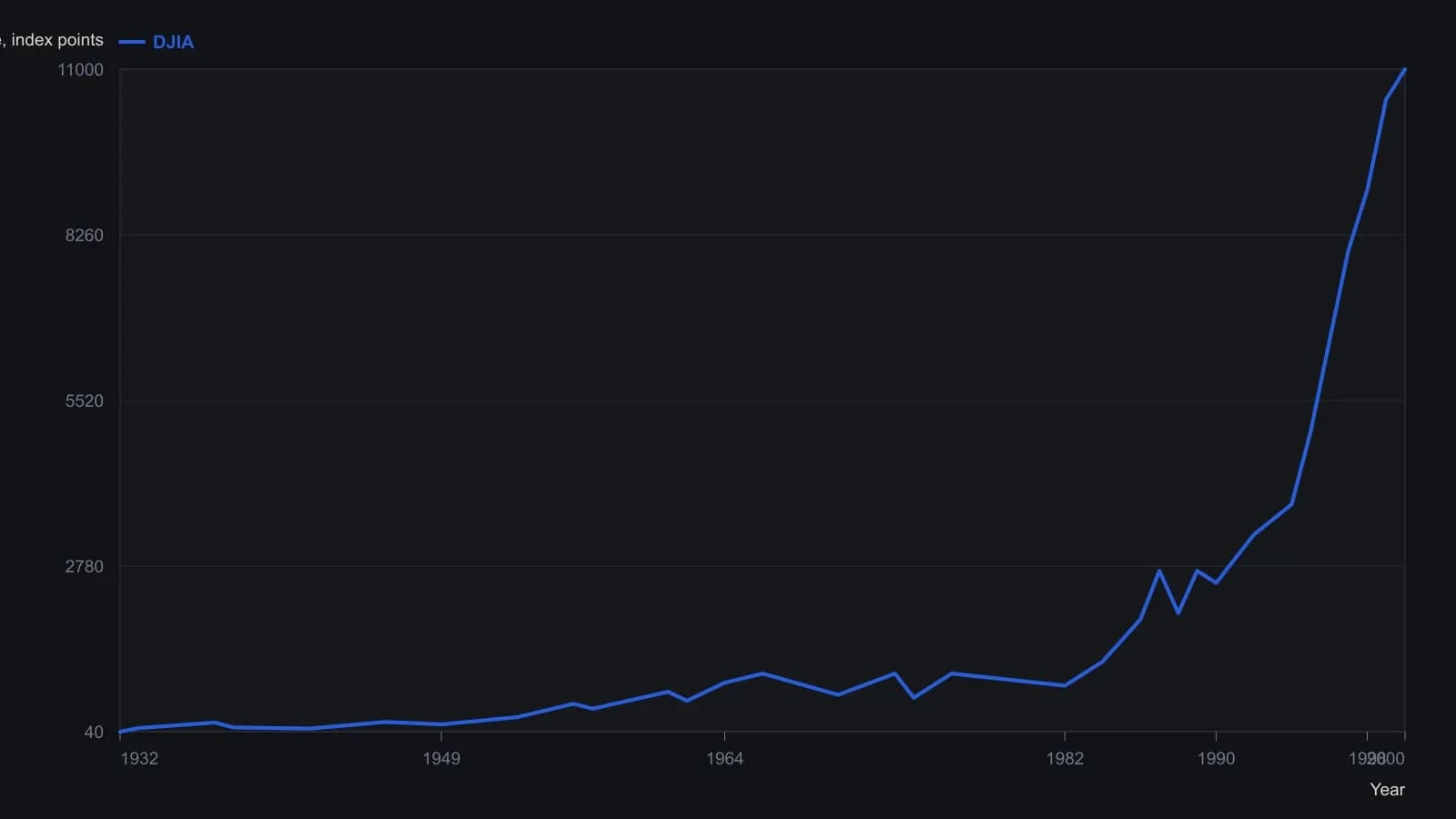
Approximate readings from a log-scale monthly bar chart. Printed y-ticks are 50, 100, 500, 1000, 2000, 6000 and 10000; values between ticks are visual estimates, not official prints.
When the shorter-than-three rule exits too soon
Rigid use of the fifth-wave-length-rule produced an expected end to the 1980s-1990s advance years before the eventual peak, including top calls around 1997 and 1998.
Editorial: re-examine the rule, keep the structure
The same critique treats that missed late extension as a reason to re-examine live fifth-wave orthodoxy rather than as a reason to abandon wave structure altogether.
Editorial reading keeps that archive conclusion and adds a working test: if a shorter-than-three rule would have ended the bull years early, the finished fifth fails as a live signal even if the broader wave structure remains useful. That test is editorial and is not attributed to the archive.
All readings on this track · 6 readings
- 1990A five-wave C finish as an Elliott count contract
- 1994Constructing impulse and corrective Elliott wave labels
- 2002When fifth-impulse rules end a bull too soon
- 2003C-wave as the final leg of an ABC correction
- 2011Treat labeled Impulse wave and Corrective wave counts as a live hypothesis
- 2015Constructing five-three impulse and corrective wave counts