1996issue C091-9
Neutral option income in a rich implied-volatility regime
A two-sided short-premium book is taken only when option premium is elevated and remaining life is short. After entry, a stay-inside zone and a position-rebalance rule decide whether the book is still a valid neutral options position.
- A two-sided short-premium book is taken only when conditions such as elevated option premium and a short remaining life are judged favorable, not on every session.
- The income structure is a neutral options position that sells an out-of-the-money put and an out-of-the-money call holding only time value, aiming to keep that premium if the underlying stays inside a wide planned range.
- Time-value decay acts on both sold options each day and accelerates as expiration approaches. An extreme move is the main harm and is handled by a position rebalance.
- A ratio spread can buy a nearer option and sell multiple farther strikes when option-skewing leaves those sold strikes richer in implied volatility.
Eligibility before any short-premium book
A two-sided short-premium book is taken only when conditions are judged favorable, such as elevated option premium and a short remaining life, rather than on every session.
The implied-volatility regime is the contract-level state of elevated or compressed option premium used to decide whether a premium-selling or strike-disparity structure is even eligible.
The stay-inside income structure
The income structure is a neutral options position. It sells an out-of-the-money put and an out-of-the-money call that contain only time value. The book is sized so it stays even if the underlying remains inside a wide planned range, and the aim is to keep that premium when price stays inside the zone.
Time-value decay on both wings
Time value on both sold options declines each day. That time-value decay accelerates as expiration approaches, so both wings of the two-sided short-premium book are eroded by the same daily process.
The structure is described as workable in a nontrending or slowly drifting market, characterized as more than two-thirds of market time. It is harmed mainly by an extreme move that then requires a position rebalance.
A Treasury-bond stay-inside zone
In a December 1995 Treasury-bond illustration, futures near 117 were paired with a 112-124 stay-inside zone by selling the 112 put and the 124 call. The sold strikes were placed below three-month lows and above contract highs.
After an extreme move
An extreme move is the main harm to the book. A position rebalance resets the short put and the short call after that move so the book stays two-sided instead of collapsing into an unplanned directional wager.
Editorial note: this reset is the second gate. If the underlying has left the planned range, the original stay-inside structure is no longer treated as valid.
March 1996 T-bond futures versus the 112–124 stay-inside zone
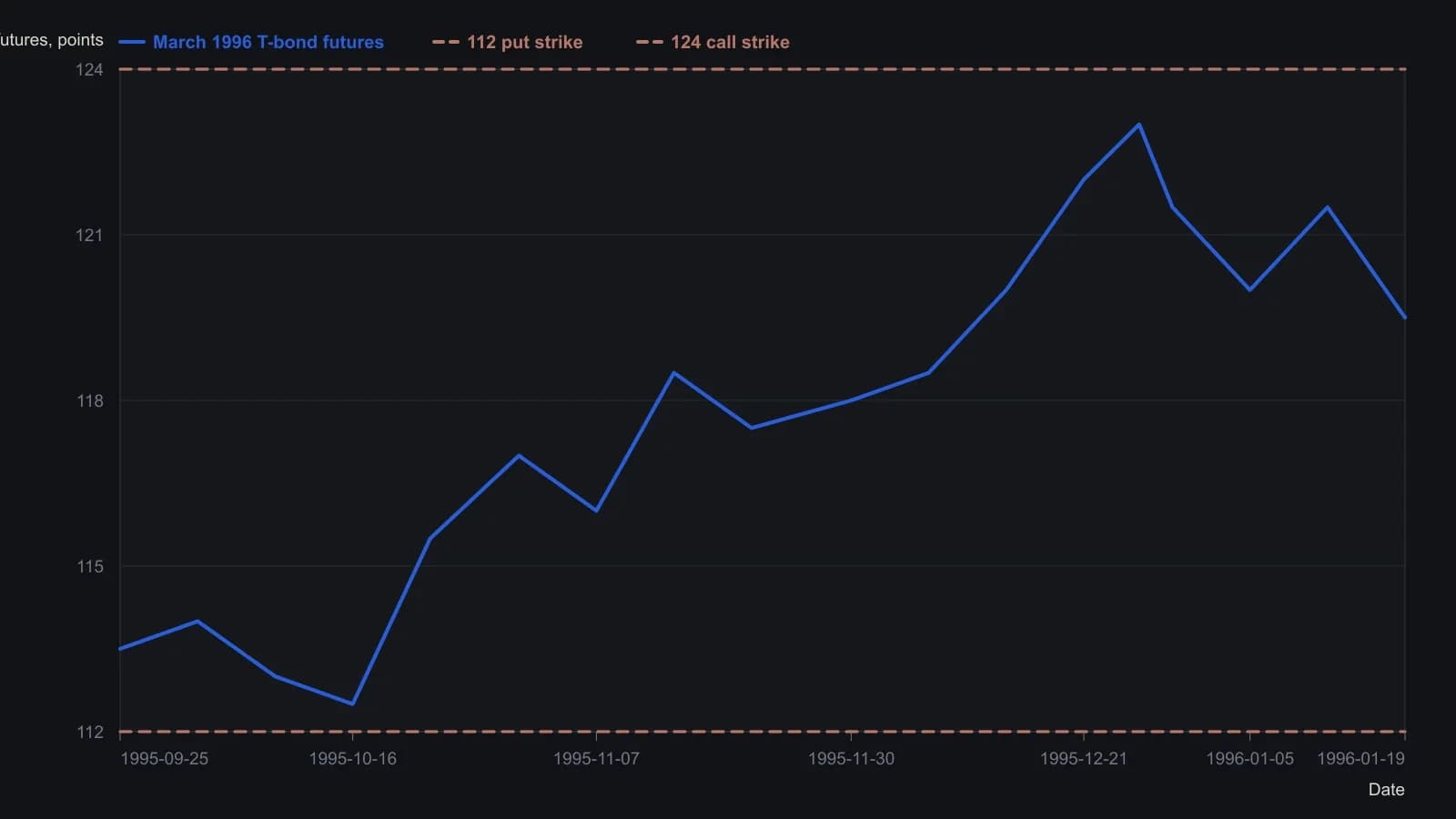
Daily candlesticks sampled about weekly and rounded to the nearest half-point; the raster does not support 32nds. The 112 and 124 lines are the sold strikes stated in the text, not drawn on the original figure. The window header quote of 111-27 on 20 March 1996 falls after the plotted dates.
Ratio spreads and option-skewing
A ratio spread buys a closer-to-the-money option and sells multiple farther out-of-the-money options that are richer in implied volatility and more exposed to time decay. Option-skewing is the strike-to-strike gap in implied volatility that can leave far out-of-the-money options priced substantially richer than comparable nearer strikes.
A May 1996 coffee illustration bought 160-strike calls and sold 180-strike calls when the sold strikes traded at implied-volatility levels up to 40% higher. That form of option-skewing is also described as often leaving out-of-the-money options 25-50% richer than comparable nearer strikes.
Contexts that change implied volatility
Contexts flagged for unusual implied volatility include pre-report spikes. Treasury-bond volatility was at a more-than-one-year high in early 1996 after postponed government releases. Other flagged contexts are holiday-period compression, seasonal grain-option increases of 100% or more from January to May 1996 in corn and soybeans, and crude-oil implied volatility doubling on early-1996 Middle East political stress.
Editorial note: these are regime examples, not a calendar of trades. Elevated premium can make a short-premium or strike-disparity structure eligible. Compression can keep the first gate closed.