2010issue C0410-13
Mechanical range trading with a global account stop
Range trading can be specified as a mechanical trading system by locking range definition, grid spacing, and a global stop-loss. Entry, exit, and abstention then sit in one bounded procedure rather than an open-ended overlay.
- Range trading harvests repeated crossings inside a predefined price band; grid spacing places sell orders above the market and buy orders below it at a pip interval that can be adjusted by currency pair.
- Range definition and oscillation count are the decisive construction inputs, and oscillation count is distinguished from total volatility.
- A 350-pip band is used to set both grid levels and the account stop, while a historically wide 4,000-pip band is treated as too broad for useful grid crossings.
- A global stop-loss closes every open position when open drawdown exceeds a preset share of equity, illustrated at 1%, and converts unbounded grid exposure into a known outlay.
The archive workflow specifies range trading as a construction that harvests repeated crossings inside a predefined price band rather than a one-way trend. It is written as a mechanical trading system: a fully specified procedure for entries, exits, and abstention that can be tested as one unit.
Grid spacing and offsetting legs
The mechanical construction places sell orders above the market and buy orders below it. The interval is grid spacing: the fixed pip interval used to stack those orders, and it can be adjusted by currency pair.
Inside a contained range the opposing grid legs are meant to offset as price oscillates. A sustained trend instead stacks additional losing positions until drawdown becomes unmanageable.
Range definition and oscillation count
Two construction inputs are treated as decisive. The first is range definition: the chosen band width, set from recent-session volatility and the pair's historical behavior.
Range identification uses average volatility over the prior five sessions, an expectation for the next five, and a comparison with the pair's historical range width. A historically wide band of 4,000 pips is treated as too broad for useful grid crossings. A 350-pip band is used to set both grid levels and the account stop.
The second input is oscillation count: how many times price traverses the defined band. Oscillation count is distinguished from total volatility.
A 100-pip walkthrough
In the 100-pip walkthrough, a winning leg is cashed, both sides are re-placed at the new price, and the opposite leg is cashed on the return trip. That sequence books 100 pips net while the leftover position is back at its start.
The global stop-loss
Account protection is a global stop-loss: an account-level rule that closes every open position when open drawdown exceeds a preset share of equity. The working illustration is 1%.
The global stop-loss is framed as converting unbounded grid exposure into a known, option-like outlay the account is willing to spend, without paying an actual premium.
Brief quiet windows
The same construction is proposed for brief quiet windows, such as ahead of a scheduled release. It can sit alongside other procedures on a short horizon.
EUR/CHF grid test: stop, gross and net
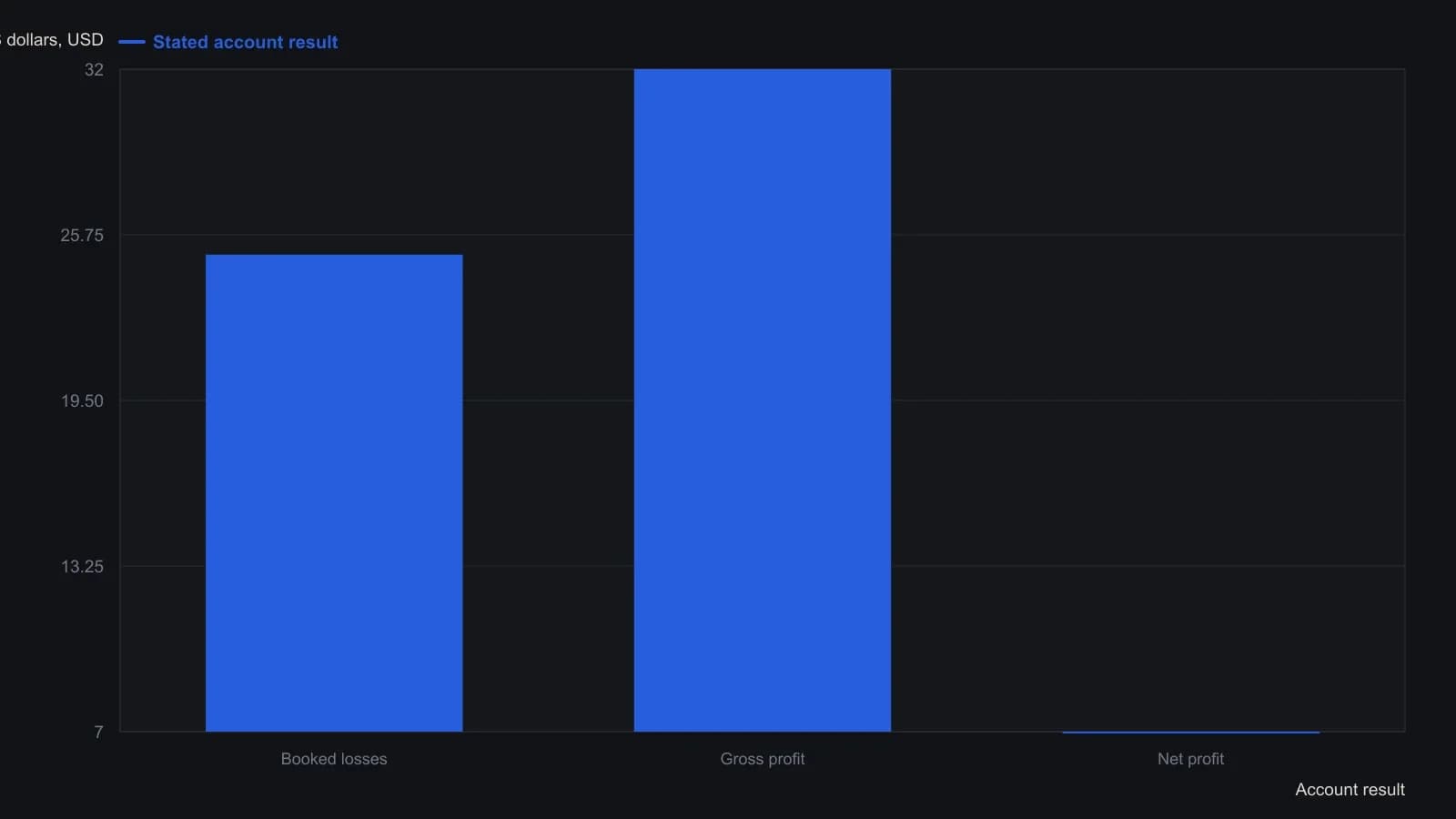
Micro lots of $1,000 were used (~$0.10 per pip). Net $7 already includes the $25 stop; the article calls gross profit “roughly $32.”
All readings on this track · 11 readings
- 1991Constructing Wyckoff readiness tests at range edges
- 1992A flat moving average as a range regime switch
- 1992A range-reentry case study with a shared adverse-excursion stop
- 1993Congestion boxes, edge candles, and the opening hour
- 1998Moving-average cross, range mode, and stop-reversals
- 2003When range regimes favor swing procedures over trend holds
- 2007Dollar range in a data-dependent rate regime
- 2008Construct a range-trade hypothesis from a price channel
- 2010Mechanical range trading with a global account stop
- 2015A quiet gold ETF range as a three-layer classroom problem
- 2016Regime-matched rules instead of price forecasts