2002issue C041-4
Constructing trend swings from confirmed pivots
A turning bar becomes a pivot only after later bars appear. Reaction days and rally days form those pivots, pivots sit inside swings, and swings compose the trend. A third-day-reversal withholds the swing and leaves the existing trend in force. A spring or failed upthrust at the prior swing extreme is the next test of that structure.
- Treat a turning bar as a pivot only after later bars confirm higher neighboring lows or lower neighboring highs.
- Withhold the swing if the third consecutive rally-day or reaction-day is a third-day-reversal, and leave the existing trend in force.
- Read a spring through a tested pivot-low, or a failed upthrust at the prior high, as the next test of the last swing extreme.
- Use swing-strength from time spent: a longer countertrend swing weakens the prevailing trend, and a shorter one does not.
A pivot waits for later bars
An OHLC bar is a pivot-low when the bars on both sides print higher lows, and a pivot-high when the bars on both sides print lower highs. A candidate turning bar is treated as a pivot only after at least three later bars appear, so a third-day-reversal is not counted as a completed pivot.
Reaction days and rally days sit under the swing
Price structure is stacked from smallest to largest. Reaction days and rally days form pivots, pivots sit inside swings, and swings compose the trend. A reaction-day makes a lower low with a high at or below the prior high. A rally-day makes a higher high with a low at or above the prior low.
A third-day-reversal keeps the old trend
In a downtrend a swing requires three days of higher highs. In an uptrend a swing requires three days of lower lows. A third-day-reversal is a third consecutive rally-day or reaction-day whose close finishes near the opposite extreme of that day's range. That close cancels the swing declaration and leaves the existing trend in force.
Broken is not the same as reversed
Higher bottoms and higher tops define an uptrend. Lower highs and lower bottoms define a downtrend. An uptrend is broken but not necessarily reversed when a swing-point low undercuts the prior swing-point low. A downtrend is broken but not necessarily reversed when the current high exceeds the prior swing-point high. A downtrend is treated as reversed only when both the latest swing high and swing low exceed the prior swing high and low. A higher swing high alone remains a potential reversal.
Springs and upthrusts test the last extreme
A spring is constructed when a close reverses two prior closes through a tested pivot-low, with confirmation described as the next session opening above the spring day's high. An upthrust construction includes reversed prior closes, a close below the pivot, a close below the open and mid-range, and a wider spread than the prior day. A failed upthrust is read as continuation rather than a buying climax.
Time in the swing is the strength reading
Pivot and swing points project support and resistance lines. The time spent in a swing is used as a swing-strength reading. A longer countertrend swing weakens the prevailing trend, while a shorter one does not.
Weekly Nasdaq Composite through the 2000–2001 downtrend
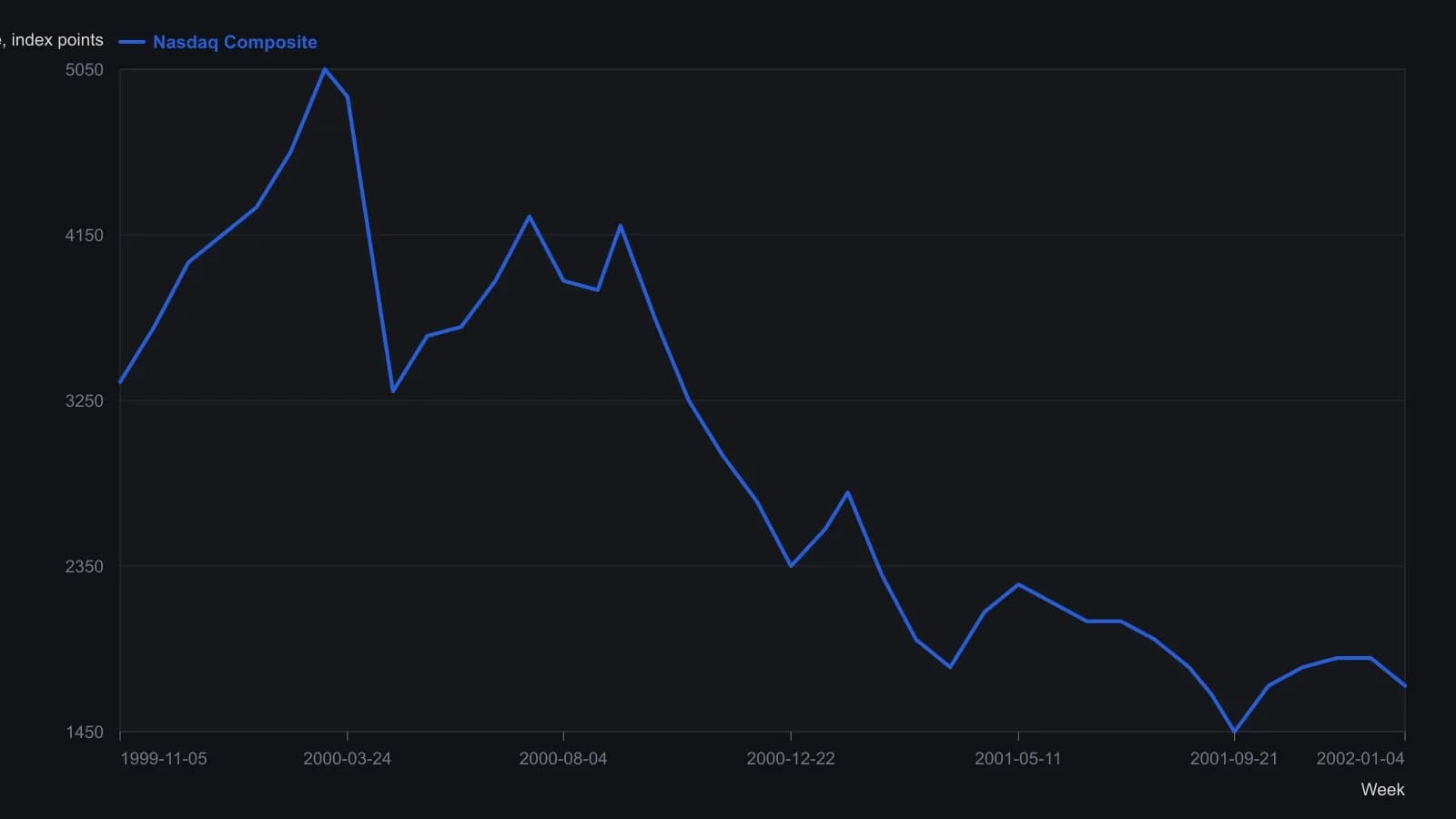
Bar levels read off the weekly pane and rounded to the nearest 50 index points, except the last close printed in the quote bar. The article’s labeled swing points A–G are not on this raster and are not invented here.
All readings on this track · 6 readings
- 1985Constructing chart congestion from triangles, springs, and pivots
- 1986Force, a tested spring, and the conservative count
- 1992Construct a Wyckoff futures read from delayed volume and range tests
- 1998A Wyckoff spring is unfinished until it is a few-parameter system
- 2002Constructing trend swings from confirmed pivots
- 2011Potential versus confirmed Wyckoff springs