2005issue C101-4
First-leg scalping with matched stops
This archive workflow treats scalping as a shorter hold on ordinary chart setups, not a new pattern book. Bank the first impulse, match the first target to the initial stop, and flatten at once if the range bound or breakout fails. The same short-horizon procedure can also manage one slice of a two-lot overlay.
- Scalping here is a shorter hold on a familiar setup: bank the first impulse and refuse to sit through a meaningful pullback.
- A roughly one-to-one risk-reward ratio sets the first profit look near the initial stop and still exits at the first fade of favorable momentum.
- The stop-loss flattens at once on a failed range bound or a breakout that does not follow through, and each setup is independent of prior fills.
- The same first-impulse procedure can scalp one lot while a second lot stays under a longer-frame umbrella overlay.
Scalping is defined here as banking the first impulse of a move and refusing to sit through a meaningful pullback. The stated premise is that faster exits can raise the count of winning trades by cutting cases where a small gain reverses into a loss.
Ordinary chart setups such as cups, double tops or bottoms, head and shoulders, and triangles are reused. Scalping is framed as a way to manage those trades rather than as a separate system.
Why the first impulse is the whole trade
Three supporting premises are stated. Brief exposure reduces the chance of an extreme adverse swing. A small price change needs less order imbalance than a large one. Small moves occur more often than long one-way trends.
Two ways the first impulse is taken
One documented scalp type uses 5,000 to 10,000 shares or more for a move of only several cents. That version is described as requiring high liquidity, a tight spread, large displayed size on both sides of the quote, and a depth-of-book display.
An illustrated breakout scalp entered as two-day resistance gave way at 1.56, exited into follow-through at 1.62 for a six-cent first impulse in about two minutes, and treated a retreat through 1.52 as the stop. The breakout-scalp procedure is entry at or just before a range break, an exit into the first burst of follow-through, and an immediate flatten if the break fails.
An illustrated range scalp bought a retreat toward 3.30 with the intent to sell a four-to-five-cent bounce, and treated a break of the 3.27 floor as an immediate flatten. The range-scalp rule is a buy of a retreat to a range floor, or the reverse at the ceiling, with a sale into the bounce and an immediate flatten if that bound breaks.
A second scalp type uses ordinary share size in higher-priced names and aims for a 15-to-30-cent first impulse. One illustrated short entered a support break at 45.85 with a 20-cent stop at 46.05 and covered about 30 cents later at the first sign of support rebuilding.
Match the first target to the stop
The working risk-reward rule is about 1:1. If the initial stop is 15 cents, the first profit look is also about 15 cents. The exit still comes at the first fade of favorable momentum, even if price later continues.
Used this way, the risk-reward ratio is a pre-trade filter that sets the first-impulse target about equal to the initial stop distance and favors more frequent small wins over a large winner-versus-loser size ratio.
Adobe short scalp: stop, entry, and first cover
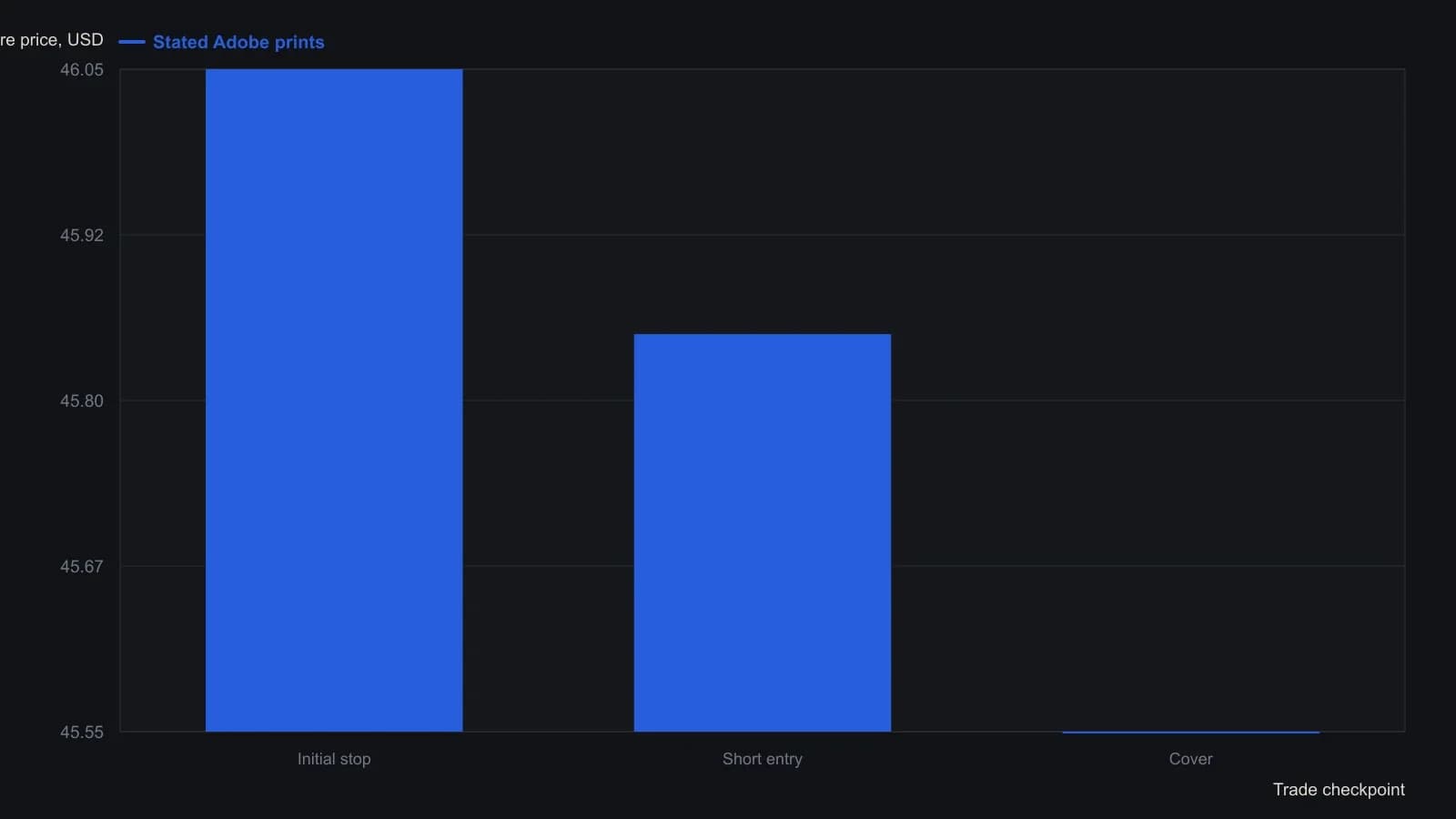
The source exits at the first hint of support firming and treats the later drop as leftover move, not a missed mandate.
Stop at the first failed action
Stop discipline is stated as necessary for survival. Flatten as soon as the name fails the expected action, including a broken range floor or the first retreat after a breakout that does not follow through at once.
The stop-loss is the pre-defined flatten level at that first failed range bound or failed breakout. It is used to bound loss before the order is placed and while the position is open.
Add it after a process already works
Each setup is treated as independent of prior fills. The style is described as something to add after a trader already has a working process, including as a defensive overlay when broader holds are being shaken out or after a losing run.
The same management style can sit inside an umbrella overlay: a two-lot hybrid that scalps the first slice and holds the second under a larger-time-frame thesis, while still trading in and out of the active slice.
All readings on this track · 7 readings
- 2000The listed cash open as a three-clock execution problem
- 2005First-leg scalping with matched stops
- 2006Holding period as a system constraint
- 2007Fair value, open prints, and sweep fades
- 2010Fixed-share fade scalping as emotion control
- 2012Forex and currency futures: pip-spread, deposit, and scalping size
- 2018Matching tape tempo on a closed yen-cross candle ticket